
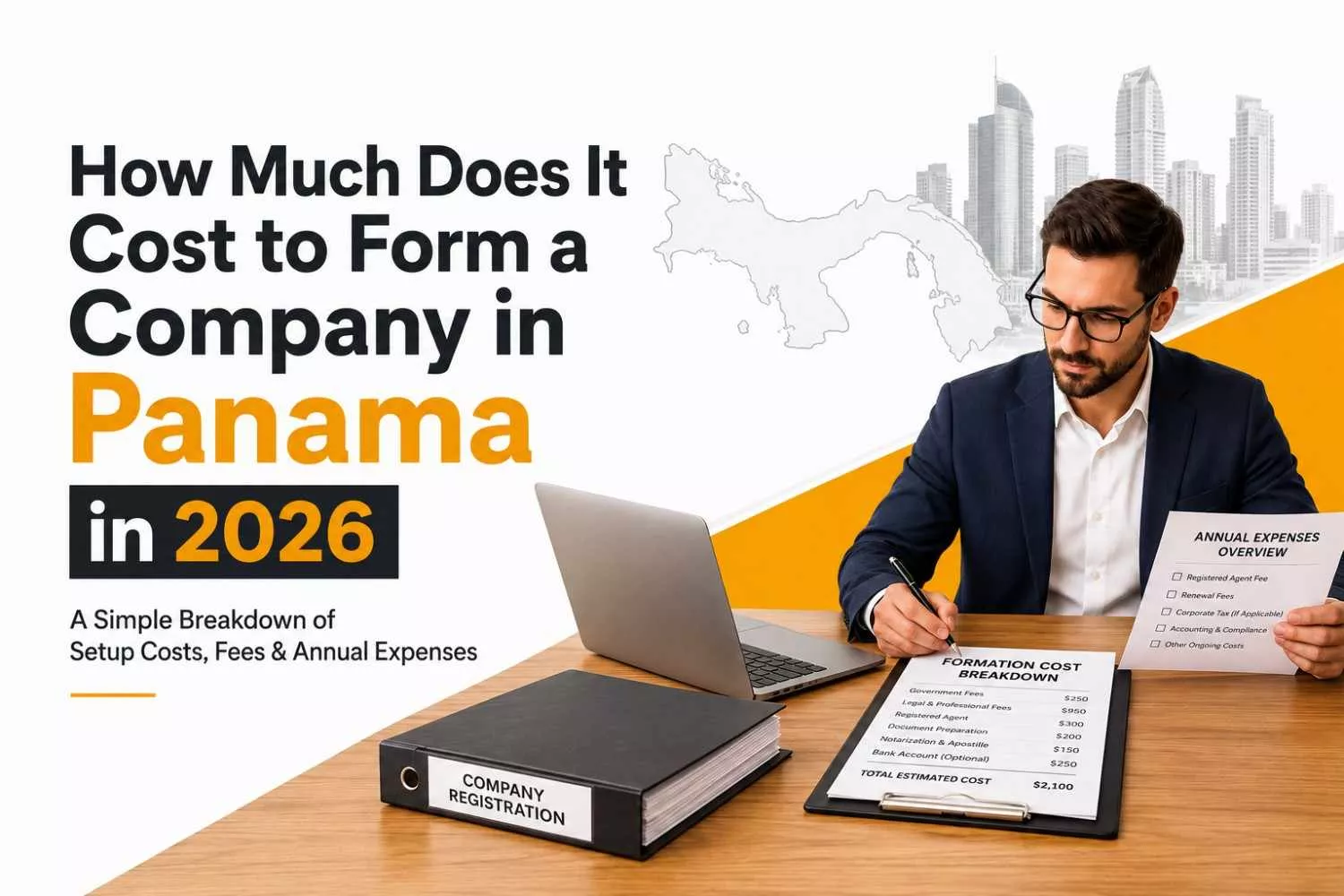
Want to open a company in Panama but not sure how much it will cost? Your total expense depends on the type of company you form and the services you need.
In this guide, you will learn the Panama company formation cost, annual fees, and any additional expenses you should expect in 2026.
Table of Contents
Why Choose Panama For Your Business?
Opening a company in Panama offers several advantages. Here are some of the main benefits you can expect.
- Territorial tax system: Panama only taxes income earned inside the country. Income your company earns abroad stays outside the Panamanian tax net, while local income is taxed at the standard corporate rate of 25%.
- Privacy and a mature legal framework: Corporations have been governed by the same core law, Law 32 of 1927, for nearly a century. Ownership information is held through a regulated private registry rather than a fully public one.
- A stable, dollarized economy: Panama uses the US dollar, maintains a strong international banking sector, and serves as a recognized hub for holding companies, trading businesses, and structures that operate across borders.
One practical update for 2026 is that Panama was removed in July 2025 from the European Union’s list of high-risk third countries for money laundering, which has eased banking friction compared with a few years ago. (Note that this is the EU’s anti-money-laundering list, which is separate from the EU’s list of non-cooperative jurisdictions for tax purposes. Panama remained on that tax list as of the EU’s February 2026 review, so the two should not be confused.) You will still face rigorous compliance, but the environment is friendlier than it once was.
Choose the Right Business Structure
The phrase “company in Panama” can mean several different legal structures, and the one you pick changes both your cost and your obligations.
You will weigh up the following three vehicles. Two of them, the S.A. and the SRL, are trading companies you can actually run a business through. The third, the Private Interest Foundation, is not a trading company at all but an asset-protection and succession tool, so treat it as a complement rather than a true alternative.
Sociedad Anónima (S.A.)
The S.A. is the workhorse structure, used in the great majority of offshore registrations, and it is governed by Law 32 of 1927.
- You need at least three directors or officers, namely a President, a Secretary, and a Treasurer, who can hold any nationality and live anywhere.
- You need at least one shareholder, which may be an individual or a company.
- There is no minimum paid-in capital. The standard authorized capital is US$10,000 divided into 100 shares of US$100, but you do not have to deposit it.
- Your shareholder details stay confidential rather than appearing in public.
Choose the S.A. if you plan to trade, provide services, or run a holding company for international business.
Sociedad de Responsabilidad Limitada (SRL), the LLC equivalent
The SRL is the limited liability company equivalent, and it is governed by Law 4 of 2009.
- One or more managers, called gerentes, run the company instead of a board of directors, which gives you simpler governance.
- Members and managers appear in the Public Registry, so you get less privacy than an S.A.
- Capital is divided into quotas rather than shares, and again there is no minimum capital.
Choose the SRL if you run a closely held business, a smaller operation, or you simply prefer administrative simplicity over maximum privacy.
Private Interest Foundation (PIF)
A Foundation is not a trading company at all. It works as an asset-protection and estate-planning vehicle, governed by Law 25 of 1995. You will often see people pair a Foundation with an S.A. or SRL, where the company trades and the Foundation holds the shares for succession purposes. Setup and yearly costs feel broadly similar to a corporation, with one difference worth noting: the annual franchise tax for a Foundation is US$400, rather than the US$300 a corporation pays. You cannot use a Foundation for ordinary commercial activity.
Cost takeaway: the S.A. and the SRL cost roughly the same to form. The biggest swings in your bill come from optional services such as nominee directors, powers of attorney, and bank account assistance, rather than from the entity type itself.
How Much Does It Cost to Form a Company
The breakdown below shows you where the money actually goes. You will find it split into initial formation costs, optional add-ons, and recurring annual costs.
First-Year Formation Costs
| Item | Typical 2026 cost (USD) | What it covers |
|---|---|---|
| Professional or incorporation package | $1,000 to $2,600 | Legal drafting of your Articles of Incorporation (the Pacto Social), notary execution as a public deed, and filing at the Public Registry. Most reputable firms bundle the items below into this. |
| Government registration and filing fees | Usually included in the package | Official fees paid to the Panama Public Registry to register the company. |
| First-year resident agent | Usually included | A licensed Panamanian attorney or law firm is legally required as your resident agent. |
| First-year franchise tax (Tasa Única) | $300 (often included) | The mandatory annual government levy, frequently prepaid in first-year packages. |
| Certified corporate documents | Usually included | A certified copy of the Articles of Incorporation and a Certificate of Good Standing. |
| Apostille and certified English translation | Usually included | Needed so your documents are recognized abroad, especially for banking. |
| Courier delivery (for example DHL) | $50 to $150 (sometimes extra) | Physical delivery of your original certified documents. |
When you add it up, a clean and simple S.A. or SRL set up remotely realistically costs you between $1,000 and $1,800. Packages reaching $1,900 to $2,600 usually include extra certified documents, nominee services, or a faster and more hands-on process.
Optional Services and Extra Costs
| Add-on | Typical 2026 cost (USD) | Notes |
|---|---|---|
| Nominee directors | About $100 per director per year (3 needed, about $300) | Used for privacy. Some firms quote $300 to $500 per director. An S.A. needs three. |
| Nominee director appointment | About $450 one time | A setup fee is charged by some firms to install their own people as directors, subject to due diligence. |
| Apostilled General Power of Attorney | About $100 | Lets you or a representative sign contracts, open bank accounts, and act for the company. Common when you use nominees. |
| Bank account opening assistance | $0 to several hundred or more | Varies widely by bank and firm. Banks apply strict know-your-customer checks. |
| Company kit or corporate seal | $50 to $150 | A physical book, share certificates, and a common seal. Often included. |
| RUC (tax ID) registration | $100 to $300 | Needed once you take on local tax obligations. |
Annual Maintenance Costs
Many people forget the yearly upkeep, so plan for it now. The annual maintenance below keeps your company alive and in good standing.
| Annual item | Typical 2026 cost (USD) | Mandatory? |
|---|---|---|
| Tasa Única (annual government franchise tax) | $300 (S.A. / SRL); $400 (Foundation) | Yes, for every registered entity. |
| Resident agent renewal | $150 to $450 | Yes, legally required. |
| Registered office address | Often bundled with the agent | Yes. |
| Accounting records and annual submission to resident agent | Varies by activity (bookkeeping help) | Yes see below. |
| Nominee directors renewal | About $300 total (if used) | Only if you use nominees. |
Beyond paying your resident agent and registered-office fees, you must stay on top of three recurring compliance obligations to keep your Panamanian company active and avoid serious penalties.
- First, you must deliver your accounting records (or a financial summary) to your resident agent by 30 April every year, which will require a modest annual bookkeeping budget even if the company is dormant.
- Second, you must pay the annual government franchise tax (Tasa Única). It falls due by 15 July if your company was formed between January and June, or by 15 January if it was formed between July and December.
- Finally, you must keep your ultimate beneficial ownership information up to date with your resident agent.
Failing to comply is a serious matter: missing the tax deadline triggers late surcharges, and prolonged non-payment can lead to suspension and, eventually, dissolution. Failing to provide your accounting records can result in devastating fines ranging from $5,000 to $1,000,000, the suspension of your corporate rights, or the forced dissolution of your company.
A realistic annual maintenance budget sits between $450 and $1,000, depending on whether you use nominees and how much bookkeeping help you need. You will sometimes see firms advertise zero annual costs, but the phrasing simply means the franchise tax and agent fee are folded into one renewal invoice. The costs are never truly zero.
Example Cost Scenarios
Your total cost depends on how you plan to use your Panama company. The examples below show what you can expect to pay in three common situations.
A. Offshore Holding Company
If you plan to hold assets or serve clients outside Panama, you should choose this setup.
Your first year usually costs between US$1,200 and US$1,500. This amount covers company formation, your resident agent, the annual franchise tax, certified documents, and courier delivery. From your second year, you can expect to spend US$450 to US$600 each year. This amount covers your resident agent and the annual franchise tax. Remember to add a small annual bookkeeping cost to satisfy the accounting-records obligation, even when the company is dormant.
B. Privacy-Focused Offshore Company
This option suits you if you want greater privacy or prefer nominee directors.
Your first year usually costs between US$1,800 and US$2,600. This amount includes company formation, nominee directors, the appointment fee, and a power of attorney. From your second year, you can expect to spend US$750 to US$1,000 each year. This amount covers nominee renewals, your resident agent, and the annual franchise tax.
C. Company Operating Inside Panama
If you plan to operate your business inside Panama, you should choose this setup.
Your first year usually costs between US$1,500 and US$2,500. This amount includes company formation, your Operations Notice (Aviso de Operación), and tax registrations. From your second year, you pay your resident agent and the annual franchise tax, plus accounting, tax filings, and other local compliance.
If your business earns income in Panama, you also pay corporate income tax (25% on net taxable income) and other applicable taxes. The two that most often catch onshore operators by surprise are the Operations Notice tax, an annual levy of 2% on the company’s net equity with a minimum of US$100 and a maximum of US$60,000, and ITBMS, Panama’s value-added tax, charged at a standard rate of 7% on most goods and services.
Are you thinking about a company in Panama? Request a free and itemized formation quote along with a short structure consultation. Our advisors will tell you exactly what your setup costs in your first year and every year after.
Frequently Asked Questions
Do you need to visit Panama to form a company?
Usually, you do not, because most formations follow a sign-abroad and file-locally process that your resident agent handles remotely. You may need to appear in person only when a specific bank requires it.
Is there a minimum capital requirement?
There is none, because neither the S.A. nor the SRL requires a minimum paid-in capital. The US$10,000 across 100 shares you will see quoted is simply the standard authorized capital, and you never have to deposit it.
Do you have to file audited financial statements?
No. A standard offshore company does not file audited accounts, public filings, or annual tax returns, and since Executive Decree 177 of 2024 the records no longer need CPA certification. You are, however, legally required to keep accounting records and to submit them, or a sworn financial summary, to your resident agent every year by 30 April. Your agent holds them privately and produces them only if the authorities ask. Onshore companies with local income additionally file financial statements and tax returns.
How long does the whole process take?
You should expect incorporation to take about three to ten business days, plus one to three weeks if you also need a bank account or apostilled documents delivered.
Which cost can you never avoid?
You always pay the US$300 annual Tasa Única (US$400 for a Foundation) plus your resident agent fee, because every registered entity pays both to stay in good standing.
Will you owe Panama tax?
You only owe it on Panamanian income, because genuinely foreign income falls outside Panama’s tax net under the territorial system. Remember, though, that if you are a tax resident elsewhere, for example a United States person, you remain subject to your home country tax and reporting rules. Always seek advice on your cross-border position before you act.
Disclaimer: The information provided in this blog is for general informational purposes only. For professional assistance and advice, please contact experts.
