
Table of Contents
Choosing between a Panama LLC and a Panama corporation shapes how much tax you pay, how much personal liability you carry, and how much privacy you keep. Get it right and you protect tens of thousands of dollars. Get it wrong and it can cost you just as much.
This guide breaks down each Panama business structure by stage, explains the setup process and ongoing costs in plain language, and flags the tax traps that catch first-timers, so you can match the entity to where your business stands today.
A Clear Guide to Key Terms and Definitions
Before we compare structures, here are the words you will see throughout this guide:
- Limited liability: your personal assets (home, savings, car) are protected if the business is sued or cannot pay its debts. You can only lose what you put into the business.
- LLC (Limited Liability Company): a flexible entity owned by “members.” In Panama it is called an SRL (Sociedad de Responsabilidad Limitada).
- Corporation: an entity owned by “shareholders” who hold shares. In Panama it is called an S.A. (Sociedad Anónima).
- Member vs shareholder: just the name for an owner. LLCs have members; corporations have shareholders.
- Resident agent: a licensed Panamanian lawyer or law firm that every Panama entity must appoint by law to represent it locally. This is required, not optional.
- Dividend: a payment of company profit to its owners.
- Self-employment tax: a US tax (15.3%) that self-employed people pay to fund Social Security and Medicare.
- Territorial tax: Panama’s system of taxing only income earned inside Panama, and not taxing income earned abroad.
- Offshore: simply means the company’s activity happens outside Panama. It is legal, and it does not mean tax-free (more on that below).
How to Choose a Panama Business Structure
The right structure depends less on preference and more on your current stage. Before you decide, ask yourself:
- Is your business still just an idea, or already earning? Revenue changes the math.
- How much is it earning? Higher income raises the stakes of getting the structure right.
- What legal risks does it carry? More risk means more reason to limit liability.
Your answers point you toward one of four paths: staying simple, forming a Panama LLC, forming a Panama corporation, or pairing a Panama entity with a US LLC.
Key takeaway: Your structure can evolve. The entity you start with does not have to be the one you keep forever.
Why a Simple Business Structure Often Works Best for Beginners
In the earliest phase, the simplest structure is usually the smartest. Tools built to cut taxes or shield assets are expensive and often unnecessary when you have little income and few assets to protect.
Operating Without Formal Incorporation
An unincorporated business owned by one person is the cheapest, fastest way to start. If you earn 1099 income or work as an independent contractor, you already operate this way by default.
This setup works best when income and risk are both low:
- Low income benchmark: under $50,000 a year in net business income.
- Lower bracket, lower bill: your tax is based on income, so this is a low-stakes stage to keep things simple.
- Still deductible: you can reduce taxable income with the home office deduction, depreciation, business meals, and retirement contributions.
The tradeoff is liability. You and your business are treated as one, so you are personally liable for every business debt, and creditors can pursue your personal assets. This only makes sense when the chance of your business failing to cover its own debts is low.
Operating With a Partner or Co-Founder
Starting with others? The equivalent entry structure is a general partnership. It works like operating alone, but with two or more owners.
- Still unincorporated, with the same low-income, low-liability fit.
- Put a written operating agreement in place so everyone is aligned.
- Obtain an EIN (Employer Identification Number, a business tax ID) from the IRS, or the equivalent in your jurisdiction.
Growing Your Business: When to Set Up a Panama LLC
As income steadies or risk rises, it is time to limit your personal liability. That is exactly what a limited liability company does: it protects your personal assets from business debts and lawsuits, whether your income is modest or substantial.
The LLC Tax Myth
A common misconception is that an LLC lowers your taxes. It does not.
- The deductions available to an LLC are the same as under a sole proprietorship or partnership.
- Set up an LLC to protect assets, not to reduce taxes.
Panama LLC (SRL) Requirements at a Glance
In Panama, the LLC is the Sociedad de Responsabilidad Limitada (SRL). Key facts:
- Members: at least two, with their identities recorded publicly on the public registry.
- Ownership split: no rule on how percentages must be divided between members.
- Management: at least one manager required.
- Governing law: enacted in 2009, making it newer than the corporation.
A Bonus for US Citizens
The Panama LLC lets you make a check-the-box election with the IRS (choosing how the entity is taxed on your US return), which can help you:
- Claim a foreign tax credit, or
- Transfer net operating losses to your US return.
Because this involves US tax law, consult a qualified US accountant before electing.
Scaling Up: When a Panama Corporation Fits Better
As your business grows and you want more structure, credibility, or privacy, a corporation often becomes the better fit. In Panama this is the Sociedad Anónima (S.A.), referred to in English as an Inc, Corp, or corporation.
Panama Corporation (S.A.) Requirements at a Glance
- Ownership: held by shareholders who own shares, not membership interests.
- Shareholders: can be a single owner, though forming one requires two subscribers to sign the incorporation documents, a role your resident agent typically fills.
- Directors: at least three, more than the single manager an LLC needs.
- Liability: shareholders receive limited liability protection.
A Proven, Flexible Framework
Panama’s corporation law has stayed largely unchanged since it was modeled after Delaware corporate law in the early twentieth century.
- That stability and flexibility keep it the most common entity for general business in Panama.
- Even with the newer LLC available since 2009, corporations are still set up more often.
- Often the choice simply comes down to owner comfort and familiarity.
Panama LLC vs Corporation: The Privacy Difference
Privacy is one of the clearest differences between the two:
- LLC members sit on the public registry for anyone to see.
- Corporation shareholders are not made public.
- But managers are visible either way: directors of a corporation and managers of an LLC both appear on the public registry. Many owners appoint nominee directors to add separation.
- A private layer exists too: beneficial ownership is reported to a separate private registry, accessible to authorities only under defined legal conditions such as a criminal or tax investigation.
Bottom line: if owner privacy is a priority, a corporation is generally the stronger choice.
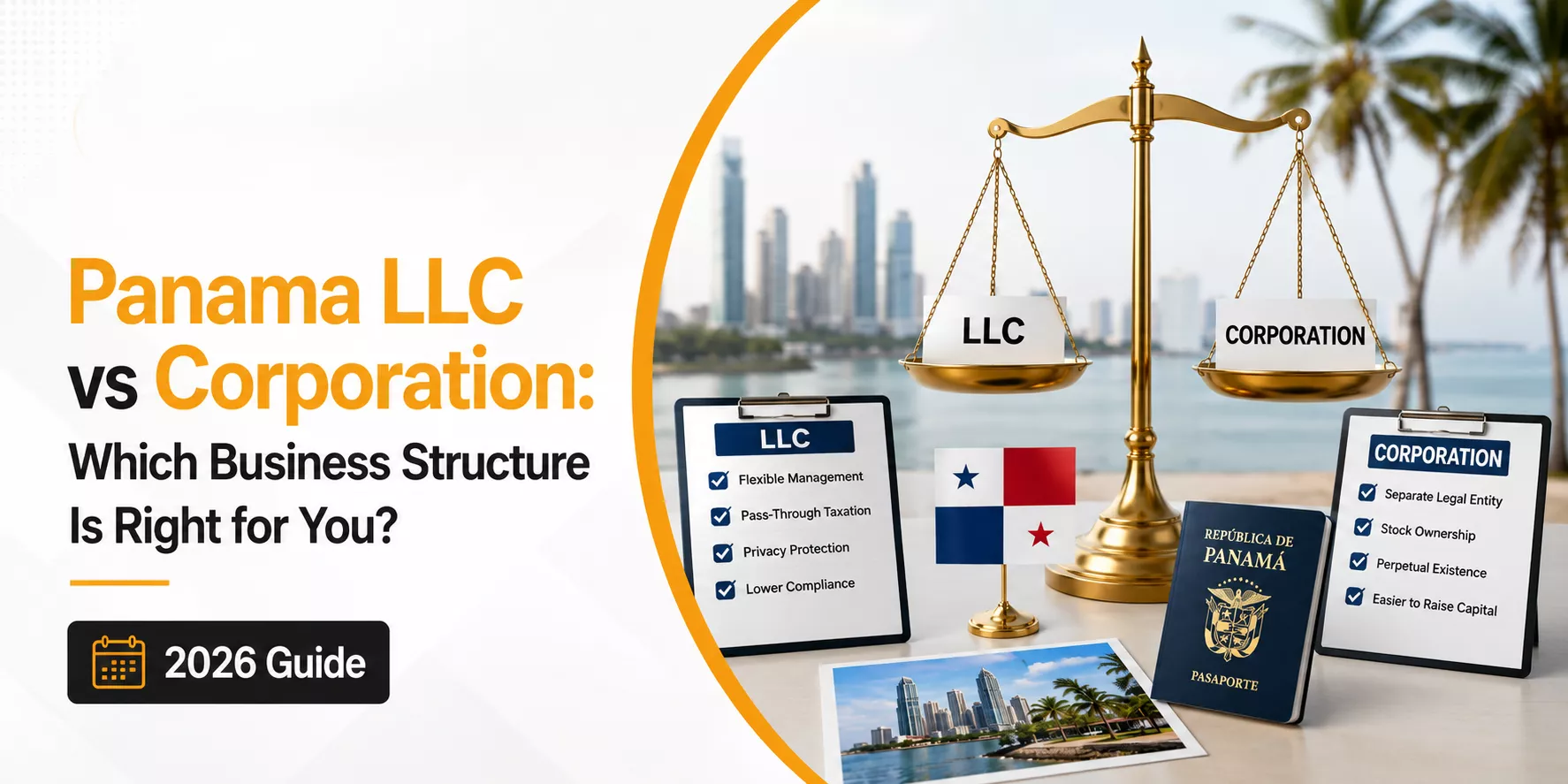
Panama LLC vs Corporation: Side-by-Side Comparison
| Feature | Panama LLC (SRL) | Panama Corporation (S.A.) |
|---|---|---|
| Owners called | Members | Shareholders |
| Minimum owners | 2 members | 1 shareholder (2 subscribers to form) |
| Management | At least 1 manager | At least 3 directors |
| Is the owner’s name public? | Yes, on the public registry | No, kept private |
| Manager/director names public? | Yes | Yes |
| Governing law | Law 4 of 2009 | Law 32 of 1927 |
| Tax on Panama-source income | 25% | 25% |
| Tax on foreign-source income | 0% | 0% |
| Best for | Growing businesses wanting asset protection | Scaling businesses wanting privacy and credibility |
How to Set Up a Panama Company (Step by Step)
The whole process can be handled remotely, and foreigners can own 100% of a Panama entity. You do not need to live in or visit Panama, though some banks ask for an in-person interview to open an account.
Typical steps:
- Choose a company name and have your resident agent confirm it is available.
- Appoint a resident agent (a licensed Panamanian lawyer or law firm), which is legally required.
- Submit your KYC documents passport, proof of address, and a source-of-funds explanation.
- Your agent drafts and files the Articles of Incorporation with the Public Registry.
- Receive your registration number (called a Ficha or Folio) confirming the company exists.
How Long It Takes
- Registration: about 3–7 business days once documents are ready.
- Full process: typically 2–4 weeks, since gathering documents is the slow part.
- Bank account: add another 1–3 months.
Minimum Capital
- There is no minimum paid-up capital. You do not have to deposit a set amount to form the company.
- The standard authorized capital is $10,000, which is a nominal figure on paper, not cash you must hand over.
What a Panama Company Costs
When planning, you have to look at two different budgets: your one-time setup fee and the annual upkeep. The numbers below are typical ranges, not final quotes.
- Formation: roughly a few hundred to $1,000+, depending on the provider and structure.
- Annual franchise tax (tasa única): $300 per year, paid to keep the company in good standing.
- Resident agent fee: commonly $500–$1,500+ per year.
- Accounting and filings: varies with activity; an offshore, non-operating company files a simple declaration, while a company earning Panama income needs audited local filings.
Staying Compliant: Annual Obligations You Cannot Skip
A Panama company is not “set it and forget it.” Every entity must be maintained each year or it risks penalties.
- Franchise tax (tasa única): $300 due by January 15 or July 15, depending on your incorporation date.
- Accounting records (Law 52 of 2016): keep records and supporting documents for at least 5 years and submit them to your resident agent annually.
- Beneficial owner reporting (Law 129 of 2020): your ownership information is filed with a private, restricted registry through your resident agent.
- Keep a resident agent at all times: going without one for more than 90 days can suspend your company’s rights.
What happens if you ignore this: suspension of corporate rights, escalating late penalties, and eventually forced dissolution of the company.
Opening a Panama Bank Account: Set Realistic Expectations
For many owners, banking is the hardest and slowest part of the whole project.
- Expect strict anti-money-laundering and know-your-customer (AML/KYC) checks.
- Some banks require an in-person interview.
- Applications can take weeks to months, and some are declined.
- Tip: prepare thorough documentation and consider backup options in more than one jurisdiction.
Panama Offshore Taxes: What Both Entities Share
Panama taxes both entities the same way. These entities serve two main uses: running a business, or holding property and bank accounts inside or outside Panama (often called operating offshore).
Offshore is not a separate entity type. It is the same entity with different tax treatment.
- Activity outside Panama: treated as offshore and owes no tax in Panama.
- Income inside Panama: must file a return and pay Panama’s applicable taxes.
The 25 Percent Rate Applies to Both
- Both the LLC and the corporation pay the same 25 percent income tax on Panama-source income.
- Companies with over $1.5 million in annual taxable income may fall under an alternative minimum calculation, but the flat 25 percent covers most businesses.
- Neither entity has a tax edge here, so decide on liability, privacy, and operations, not the rate.
Important: “Offshore” Does Not Mean Tax-Free
This is the trap that catches first-timers. A Panama company can be free of Panama tax while you still owe tax and filings at home.
- Your home country still taxes you. US citizens are taxed on worldwide income and must file US returns no matter where their company is, because there is no US–Panama tax treaty.
- Owning a foreign company triggers extra US reporting. Depending on your situation, this can include:
- FBAR (FinCEN Form 114) once your foreign accounts exceed $10,000 combined.
- FATCA (Form 8938) above the filing thresholds.
- Form 5471 for owning a foreign corporation, plus possible CFC/GILTI and PFIC rules.
- Where you manage the company matters. If you run it from your home country, tax authorities there may treat it as tax-resident locally or as having a taxable presence.
Ask your advisor about: worldwide income reporting, FBAR and FATCA thresholds, Form 5471, and whether your home country’s controlled-foreign-company rules apply. Treat this as questions to raise, not filing instructions.
US LLC Owners: When to Elect S Corp Status
Many owners pair their Panama entity with a US LLC to serve American customers more easily. Once that US LLC earns meaningful profit, a new decision appears. The IRS lets an LLC or C corporation request S corporation status.
Two Benefits of Electing S Corp
- Lower self-employment tax: you avoid the full 15.3 percent that sole proprietors, partnerships, and standard LLCs pay. You take a reasonable salary that stays subject to payroll tax, while remaining profit is distributed free of that 15.3 percent, which is where the savings come from.
- Single layer of tax: income is taxed once at your personal rate, not twice like C corporation income can be.
The Cost and the Income Threshold
An S corp adds tax filings, a payroll system, and administrative work. That cost drives the timing:
- Above $50,000 net income after deductions: election typically starts to make sense.
- Wait until $75,000 if you are unsure how much you can deduct or are still missing deductions.
- Below those levels: the added cost can outweigh the savings.
- Liability is unchanged: you already have limited liability through the underlying LLC or corporation.
The C Corporation: Maximum Separation, Higher Tax Exposure
At the far end of the spectrum sits the C corporation, offering the most separation between a business and its owners.
- Perpetual life: it can continue even after owners leave or pass away, unlike an LLC, which is typically dissolved.
- Top-tier asset protection: that separation gives owners the highest level of protection available.
- The tradeoff is double taxation: income can be taxed at the corporate level and again as dividends, so its value depends on how your corporate and dividend rates compare.
Why Panama’s S.A. still wins for many: it delivers strong separation without imposing this double taxation on Panama-sourced business activity, keeping it a strong option as you scale.
Panama Business Structure Summary by Stage
Match the structure to your stage now, and let it evolve as you grow:
- Just starting, low income and risk: an informal, unincorporated setup may be enough.
- Income or risk rising: a Panama LLC adds personal asset protection without tax complexity.
- Scaling with privacy or credibility in mind: a Panama corporation is often the better long-term fit.
- Also running a US LLC: an S corp election can cut your US tax bill once income clears the $50,000 to $75,000 range.
Talk to a Professional Before You Decide
This decision affects your taxes, liability, and privacy for years, and the cross-border tax rules above are easy to get wrong. Before you file anything, get personalized guidance.
A qualified advisor can review your business stage, income level, risk exposure, and home-country obligations, then recommend the structure that fits where your business is headed. Schedule a consultation to get advice tailored to your situation.
Frequently Asked Questions
Can a foreigner own 100% of a Panama company?
Yes. Panama’s laws allow foreign nationals and non-residents to fully own a company, and no local partner is required.
Do I have to visit Panama to set one up?
No. The entire incorporation can be handled remotely through your resident agent. Some banks, however, ask for an in-person interview before opening an account.
How much does it cost each year?
Plan on the $300 annual franchise tax plus your resident agent fee (commonly $500–$1,500+), and accounting or filing fees that depend on your activity.
Will I still owe tax in my home country?
Very likely, yes. Panama’s territorial system only affects Panama tax. US citizens, for example, are taxed on worldwide income and have extra reporting obligations. Always confirm with an advisor where you live.
Do I need a minimum amount of money to start?
No. There is no minimum paid-up capital. The standard $10,000 authorized capital is a figure on paper, not cash you must deposit.
Which is better, the LLC or the corporation?
Neither is universally better. The LLC is simpler and great for asset protection as you grow; the corporation offers more privacy and credibility as you scale. Your stage, privacy needs, and comfort level decide it.
Disclaimer: The information provided in this blog is for general informational purposes only. For professional assistance and advice, please contact experts.
