
Table of Contents
Panama has quietly become one of the most strategic bases in the Americas for entrepreneurs, investors, and remote business owners. A fully dollarized economy, a territorial tax system, a stable banking sector, and a location that sits within US business hours make it less of a “move abroad” decision and more of a business-structuring one.
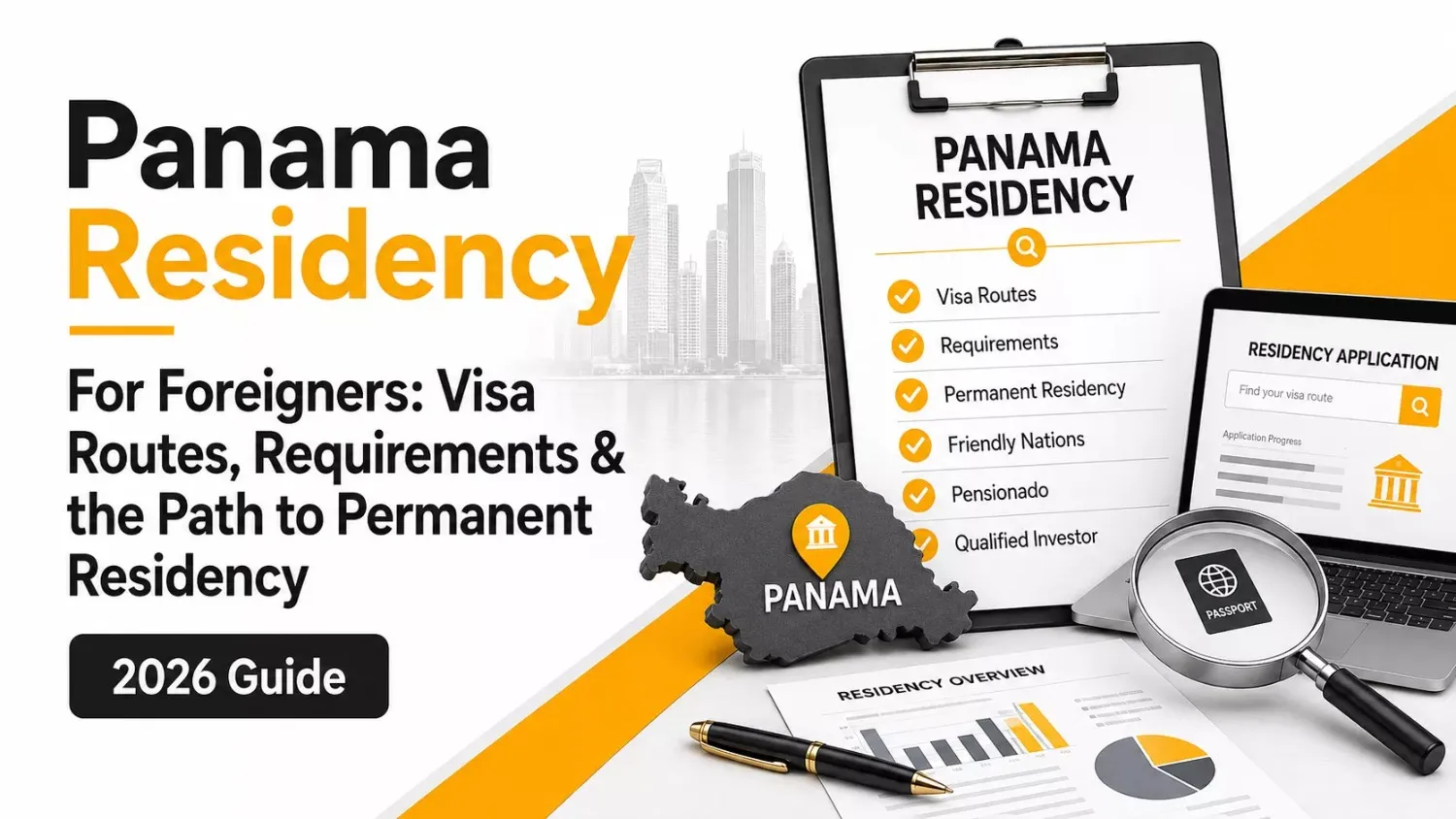
In this guide, we will walk you through every residency path available in 2026, along with the exact requirements for each.
Why Investors Choose Panama For Business Incorporation
Panama is built around international commerce. The Panama Canal, the Colón Free Zone, and a long roster of multinational regional headquarters have shaped a country that is genuinely set up for cross-border business rather than just tourism or retirement.
- A dollarized economy. Panama uses the US dollar in everyday circulation (the balboa is pegged 1:1), so you carry no currency risk and no exchange rate guesswork on revenue, deposits, or asset values.
- Territorial taxation. Income you earn outside Panama is generally not subject to Panamanian income tax. For founders and investors with foreign-sourced revenue, this is the core attraction.
- A real banking and corporate hub. Panama has a deep international banking sector, established corporate and foundation structures, and a professional services ecosystem used to working with foreign owners.
- Strategic location and time zone. Three and a half hours from many US cities and aligned with US business hours, Panama works as an operational base rather than a remote outpost.
- Residency that doubles as diversification. Most routes are tied to a deposit, property, or business presence, which is capital you control rather than a fee you forfeit, and several lead to a second passport after five years.
- Lifestyle that supports the work. Costa del Este, one of Panama City’s most expensive districts, is often compared to parts of Miami, and several other neighbourhoods read like South Florida. Living costs run higher than in much of Latin America, but you are paying for an elevated, business-friendly standard of living.
Panama Residency Options at a Glance
| Residency Path | Investment or Income | Result |
|---|---|---|
| Fixed Term Deposit (Self-Economic Solvency) | $300,000 deposit, three-year term | Provisional residency that converts to permanent |
| Real Estate Investment (Self-Economic Solvency) | $300,000 of equity in Panamanian property | Provisional residency that converts to permanent |
| Pensionado (Retirement) Visa | $1,000 monthly income, plus $250 per dependent | Immediate permanent residency |
| Friendly Nations Visa | Employment, your own company, $200,000 property, or $200,000 deposit | Two-year provisional, then permanent |
| Qualified Investor Visa (fast track) | $300,000 property, $500,000 securities, or $750,000 deposit | Immediate permanent residency |
1. Residency by Fixed Term Deposit (Self Economic Solvency)
Under Panama’s Self Economic Solvency program, you can qualify by placing a fixed-term deposit (a certificate of deposit) of $300,000 in a Panamanian bank with a general license. The balboa is pegged to the US dollar, so this amount equals $300,000 USD.
Your deposit must be held for a minimum of three years and stay free of encumbrances while your residency depends on it. This route first grants you a two-year provisional residency. Once you have held it for two years and your investment is still in place, you convert to permanent residency, which is then indefinite. From that point, the main document you renew going forward is your national ID card (cédula).
Requirements
- Deposit amount. You place $300,000 in a fixed-term deposit with a minimum term of three years, held in your own name.
- Source of funds. You show that the money came from outside Panama.
- Bank certification. You provide a certificate from the Panamanian bank confirming your deposit, its value, and its term.
- Bank Reference Letter: Original Bank Reference Letter (Not older than 6 months)
- Passport. You bring a valid passport with at least 6 months of validity remaining.
- Clean record. You supply a police background certificate covering the last 2 years, apostilled or authenticated.
- Health certificate. You obtain one issued in Panama by a licensed physician.
- Sworn statement. You sign a sworn declaration of your personal background.
- Dependents. You add $2,000 to the deposit for each dependent you bring with you.
- Spouse. You provide your marriage certificate, apostilled or authenticated.
- Children. You provide a birth certificate for each dependent child (under 18, or 18 to 25 if a single, full-time student).
2. Residency by Real Estate Investment (Self-Economic Solvency)
If you would rather hold property than cash, this route is for you. Instead of a deposit, you place at least $300,000 of equity into titled Panamanian real estate, free of liens. If the property is worth more than $300,000, you can finance the amount above the threshold locally, but your own equity must still reach $300,000. Like the deposit route, it grants you a two-year provisional residency that converts to permanent residency once you meet the holding period.
Requirements
- Investment amount. You put at least $300,000 of equity into titled Panamanian real estate, free of liens.
- Source of funds. You show that the money came from outside Panama.
- Public Registry certificate. You provide a certificate proving ownership in your name (or your Private Interest Foundation), confirming the property is unencumbered and valued at $300,000 or more.
- Passport. You bring a valid passport with at least 6 months of validity remaining.
- Clean record. You supply a police background certificate covering the last 2 years, apostilled or authenticated.
- Health certificate. You obtain one issued in Panama by a licensed physician.
- Sworn statement. You sign a sworn declaration of your personal background.
- Dependents. You add $2,000 (in deposit or property value) for each dependent you bring with you.
- Spouse and children. You provide your marriage certificate and birth certificates as applicable, apostilled or authenticated.
3. Panama Retirement Residency (Pensionado Visa)
Panama’s retirement visa, the Pensionado program, ranks among the easiest residency programs in the world, and it grants you permanent residency immediately with no provisional phase. You need only $1,000 in guaranteed lifetime monthly income to qualify.
Importantly, the Pensionado is open to nationals of any country, so it is not limited to Friendly Nations passport holders. Your income can come from a government pension, Social Security, military or VA benefits, or a lifetime annuity from a private company. There is no minimum age. The program also carries Panama’s well-known retiree discounts (under Law 6 of 1987) on healthcare, travel, utilities, and more.
Requirements
- Monthly income. You show at least $1,000/month in lifetime pension or annuity income, plus $250/month for each dependent.
- Property alternative. Your income requirement drops to $750/month if you buy Panamanian property worth $100,000 or more.
- Pension letter. You provide an official letter certifying that the income is lifetime or permanent, notarised and apostilled or authenticated.
- Nationality. You can be from any country, with no Friendly Nations restriction.
- Passport. You bring a valid passport with at least 6 months of validity remaining.
- Clean record. You supply a police background certificate, apostilled or authenticated.
- Health certificate. You obtain one issued in Panama by a licensed physician.
- Dependents. You can include your spouse and dependent children (under 18, or 18 to 25 if single, full-time students), with their civil documents.
Expert Advice: If you already hold a qualifying lifetime pension and want to move abroad to protect its purchasing power, apply sooner rather than later. The income threshold could rise as Panama grows more popular with American and Canadian retirees. Note that the Pensionado does not grant you the right to work for a Panamanian employer, though you can still work remotely for foreign clients or run a foreign business.
4. Friendly Nations Visa Program
The Friendly Nations Visa covers passport holders from 50-plus eligible countries, including the United States, Canada, the United Kingdom, Australia, New Zealand, South Africa, South Korea, Japan, most of the EU, and several Latin American partners.
One important update for 2026: the old shortcut of simply incorporating a Panamanian company to prove “economic ties” was eliminated in 2021 (Executive Decree 197). Today you must demonstrate a genuine economic or professional link to Panama through one of three qualifying routes: employment, real estate, or a bank deposit. The program grants you a two-year provisional residency that converts to permanent residency, with citizenship eligibility after five years.
Friendly Nations Visa: By Employment
You secure a job with a Panamanian company that genuinely operates in the country, and your employer sponsors a work permit on your behalf.
- Eligible passport. You hold a passport from a Friendly Nations country, valid for at least 6 months.
- Work contract. You have a signed employment contract with a Panamanian company.
- Work permit. Your employer secures a work permit for you from the Ministry of Labour (MITRADEL), and the company is registered with social security.
- Second ID. You provide a second photo ID, such as a driver’s license.
- Clean record. You supply a background certificate from your country of residence or citizenship.
- Health certificate. You obtain one issued in Panama by a licensed health professional.
Friendly Nations Visa: Through Your Own Business or Investment
This path fits founders who already run a successful business abroad and want to bring it into Panama’s entrepreneur scene. You can incorporate a Panamanian company that you own, with no need for local directors or outside shareholders.
A note on how this works in 2026: since the program was reformed, simply registering a company is no longer enough on its own to prove your economic tie. You back it up either by employing yourself through that company with a work permit, or by pairing it with one of the two investment routes below, which are the most reliable ways for an entrepreneur or investor to qualify today.
- Eligible passport. You hold a passport from a Friendly Nations country, valid for at least 6 months.
- Real estate route. You own titled Panamanian property worth at least $200,000, which you may finance above that amount, held in your name or an entity where you are the final beneficiary.
- Fixed-term deposit route. You place at least $200,000 in a fixed-term deposit at a general-license Panamanian bank, for a minimum of three years and free of liens.
- Company option. If you operate a genuine company, you keep a local registered agent office and budget for incorporation and ongoing company costs, since this path is not free.
- Source of funds. You show that the investment funds came from outside Panama.
- Clean record. You supply a background certificate from your country of residence or citizenship.
- Health certificate. You obtain one issued in Panama by a licensed health professional.
Expert Advice: Pursue a company-based path only if you genuinely intend to run a business in Panama, since immigration reviews the substance of your activity, not just the paperwork. If your goal is simply to hold residency, the property or deposit route is usually cleaner.
Fast Track Alternative: The Qualified Investor Visa
If you want immediate permanent residency rather than a two-year provisional period, and you have larger capital to commit, Panama’s Qualified Investor Visa (often called the Panama Golden Visa) is the route. It grants you permanent residency directly, usually within a few months.
- Real estate. You invest $300,000, though this threshold is scheduled to rise to $500,000 after October 15, 2026.
- Panamanian securities. You invest $500,000 through a licensed brokerage, held for 5 years.
- Fixed-term bank deposit. You place $750,000 for a 5-year term.
Your investment must come from abroad and stay in place for at least five years. You can include family members such as your spouse, dependent children, and dependent parents.
How Panama’s Territorial Tax System Works
Panama operates a territorial tax system. Income you generate abroad is generally not taxed in Panama. Foreign-sourced income, whether from trading, foreign property, or a foreign corporation, sits outside the Panamanian tax base because it does not originate in Panama. Income you generate locally is taxed on a progressive scale, where roughly the first $11,000 to $12,000 is tax-free, then 15% applies up to $50,000 and 25% above that.
You cannot open a Panamanian corporation, route foreign income through it, and declare everything as untaxed foreign source income while paying zero local tax. When you convert from provisional to permanent residency after two years, the government reviews your company records, tax returns, and payroll history. If you show no income or payroll taxes paid, your permanent residency application can be denied, and you will have to restart.
Expert Advice: Declare a reasonable income, in the range of $20,000 to $30,000, and pay tax on the portion above the tax-free threshold. This keeps you compliant and supports your conversion to permanent residency without exposing you to a high effective tax rate.
How to Apply For Panama Residency
The simplest way to apply is to let us handle it for you. We work with licensed Panamanian attorneys, as required by law, so your filing meets every current requirement, and we stay with you until your residency is approved.
Here’s how we help you get your Panama residency:
- Eligibility review: We assess your profile and recommend the route that is most cost-effective and straightforward for your situation.
- Document preparation: We give you a precise checklist and coordinate apostilles, authentications, and translations so nothing gets rejected.
- Banking and investment support: We introduce you to suitable Panamanian banks and help you navigate the deposit, property, or company step.
- Filing and follow-through: We manage the submission and track your case through provisional and permanent residency, and on toward citizenship.
- Family applications: We structure spouse and dependent applications alongside your own.
QReady to start your Panama residency? Book a free consultation, and we will map out your fastest, cleanest path to approval.
Quick FAQs
Can I apply for the retirement visa from the USA before coming to Panama?
You can start from the USA, but you cannot finish there. From home,e you engage your attorney, sign a power of attorney, and apostille your documents like the pension letter and police check. The application must be filed in Panama, and you have to visit once for your medical exam, biometrics, and to collect your card. Most people wrap it up in a single trip.
Do I have to live in Panama full time to keep my residency?
No, none of these programs requires full-time residence. You generally just need to enter Panama at least once within every two years. Avoid staying outside the country for more than two consecutive years. Plan longer or more regular stays only if you later want to pursue citizenship.
Can I include my spouse and children?
Yes. You can add your spouse and your children under 18, or up to 25 if they are single, full-time students. Each dependent costs a little more, either an extra deposit or extra monthly income. You also provide apostilled marriage and birth certificates.
Will my foreign income be taxed in Panama?
No. Panama taxes only income earned inside the country, so your foreign income stays untaxed locally. Note that residency does not change your tax obligations back home, so confirm your own country’s rules.
Can residency lead to a Panamanian passport?
Yes. After five years of permanent residency, you can apply for naturalisation, which includes a Spanish language test and a civics exam. In practice, Panama lets you keep your existing nationality. Confirm your home country’s dual citizenship rules before you start.
Disclaimer: The information provided in this blog is for general informational purposes only. For professional assistance and advice, please contact experts.
