
Table of Contents
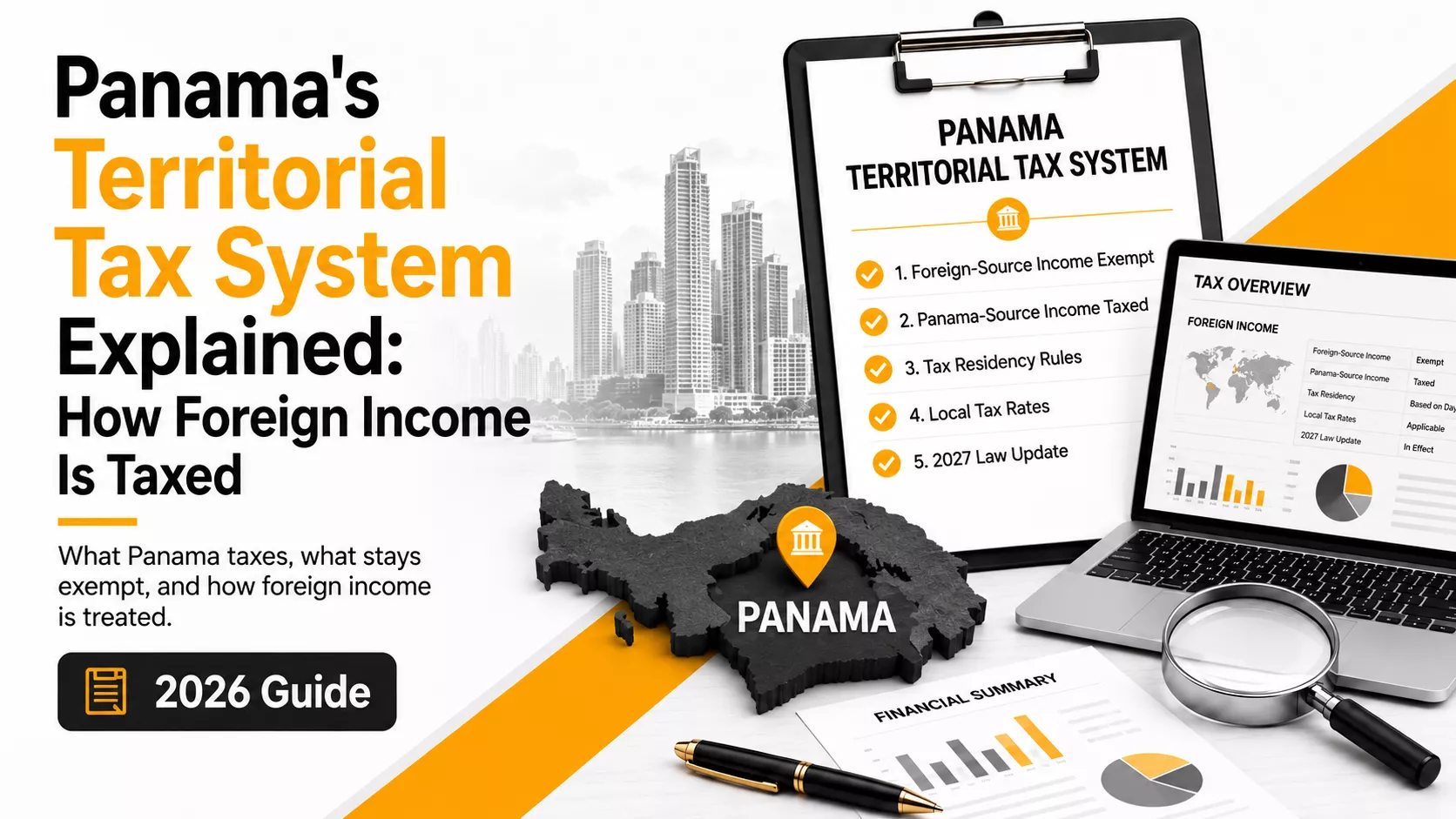
If you are moving to Panama or earning income there, you need to understand the territorial tax system. It determines whether your income gets taxed at all.
In this guide, we will walk you through the Panama territorial tax system, what it covers, what stays exempt, current local rates, and one new rule taking effect in 2027.
This guide reflects the rules as of 2026. Tax rates, dates, and the fine print of Law 526 can change, so confirm the latest details with Panama’s tax office, the Dirección General de Ingresos (DGI, at mef.gob.pa), or a local advisor before acting on anything here.
How the Panama Territorial System Works
Panama taxes only income earned within the country. Your foreign earnings stay untouched. This puts Panama in a small group of nations, since most countries tax income wherever it is earned.
The test is simple: where did the work happen? Panama’s Fiscal Code does not ask where you live or where the payment lands. It asks where the activity took place.
Work performed outside Panama counts as foreign income. Work performed inside Panama counts as local income. That single test determines your tax liability. It has nothing to do with two labels people often confuse with tax status: visa and residency.
Visa, Residency, and Tax Exemption Are Not the Same Thing
You need to keep these three ideas separate.
A visa is an immigration document. It lets you stay in the country, but it says nothing about what you owe in taxes.
Tax residency is its own status. Citizens and residents are taxed on income earned within Panama. You typically become a tax resident once you spend more than 183 days in Panama during the year, or once Panama becomes the main base for your activities. If another country asks for proof, Panama’s tax office can issue a certificate confirming your status.
The foreign income exemption stands apart from both. You do not need to be a tax resident to claim it. What matters is where your income comes from, not your visa or residency status. Even if you are a foreigner earning income on Panamanian soil, that income may still fall outside this exemption because it was earned locally.
Once you understand this distinction, the exemption itself is easy to apply.
Foreign Income Is Not Taxed in Panama
Under the territorial system, foreign-source income remains untaxed. This holds whether you are a citizen, a resident, or a recent arrival. For individuals, Panama generally applies no income threshold or cap to this exemption. Special rules can still apply to certain companies and structures, covered in the Law 526 section below.
Common types of foreign income that stay exempt include:
- Profits from a business genuinely operated abroad, with the activities actually taking place outside Panama
- A pension from another country
- Government payments like US Social Security
- Dividends, interest, and capital gains from overseas investments
Note that pay for remote work is not on this list. Where you physically perform the work matters.
This exemption forms the core of the Panama territorial tax system, and it extends further than many people expect.
Bringing Foreign Money Into Panama Stays Tax Free
Some countries attach a condition to their exemptions. They leave foreign income alone only while it stays offshore. The moment that money enters the country, it becomes taxable.
Panama takes a more straightforward approach. You can transfer foreign income directly into a Panamanian bank account, spend it locally, and it stays tax-free. Moving the money in does not convert it into local income. This distinction sets Panama apart from countries like Thailand, where the rules work differently.
Keep in mind: The reverse is also true. Moving money around does not make Panama source income exempt. The source of the income is what counts.
How Panama Taxes Local Income
Income earned inside Panama gets taxed. This includes a local job, a Panama-based business, or rent from property in Panama. Panama applies progressive rates, so each portion of income is taxed at its own bracket rate.
Amounts are counted in Balboa, and one Balboa always equals one US dollar.
- Up to 11,000: no tax
- From 11,001 to 50,000: 15 percent
- Above 50,000: 25 percent
Consider someone earning 60,000 from a job in Panama. The calculation breaks down like this:
- First 11,000: no tax, so 0
- Next 39,000 taxed at 15 percent: 5,850
- Last 10,000 taxed at 25 percent: 2,500
- Total: 8,350
If that same 60,000 came from abroad instead, no Panama tax would apply. Local income tax is not the only cost of living in Panama, though. A few smaller, everyday taxes also apply, regardless of where your main income comes from.
Other Taxes You Will Still Pay in Panama
The foreign income exemption is generous. However, if you want to live in Panama, a few everyday taxes still apply:
- Sales tax (ITBMS): Most purchases add about 7 percent at checkout, similar to sales tax in other countries.
- Property tax: Homeowners pay an annual tax; lower-value primary homes are exempt, and rates above that threshold remain modest.
- Transfer tax: Buying or selling property triggers a transfer tax, typically around 2 percent.
- Social security: Anyone holding a local job or running a local business contributes to Panama’s social security system, just like local workers.
The New Economic Substance Rule for Multinational Groups
In May 2026, Panama passed Law 526, set to take effect in the 2027 tax year. It introduces one exception to the territorial system described above.
The rule applies only to Panama companies that belong to a multinational group. It covers their foreign passive income, including dividends, interest, royalties, capital gains, real estate capital income, and other movable capital income. To keep that income tax-free, the company must show real economic substance in Panama. This goes beyond simply having an office and staff. The law also addresses local management, qualified personnel, operating expenses, and actual activities in Panama. Annual reporting requirements apply as well. If the company fails to qualify, a 15 percent tax applies to the relevant net passive income. It is not a flat charge on every foreign receipt.
A few points worth noting:
- The rule applies to companies within multinational groups, not to individuals
- A standalone Panama company with no related foreign entities generally falls outside the multinational group definition
- However, personal ownership alone does not settle the question
- If you or the company have related entities abroad, review the structure against the law
- Living in Panama on a foreign pension or salary is unaffected
- Companies meeting the substance requirements keep the exemption for the covered passive income
- This does not remove other obligations, like tax on Panama income or dividend distributions
- Some regulated businesses may be excluded, including licensed banks, insurers, and Panama-flagged shipping companies. This applies only under strict conditions.
The rule exists to meet global transparency standards. For everyone else, the territorial system continues exactly as before. That covers what Panama itself taxes.
Your Home Country May Still Tax You
Panama not taxing your foreign income does not cancel obligations elsewhere. These are two separate systems, and you may still owe tax in your country of citizenship or tax residency.
The clearest example involves the United States. American citizens are subject to IRS taxation on worldwide income, regardless of where they live, so US tax filings continue even from Panama. If you hold citizenship elsewhere, check that country’s specific rules, since each nation treats residents abroad differently. It also helps to know that your home country is likely aware of what you hold in Panama.
Your Home Country Will Probably Find Out
Your home country may have the right to tax you. There is also the question of whether it will know what you have.
Panama shares banking information with other countries through a global reporting system most nations participate in. Whether a specific account gets reported depends on your tax residence and the applicable rules. Still, the safe assumption is that your home country can see your Panama accounts. Continued filing there remains important.
If you are American, this territorial system carries extra weight. Your US tax filings continue no matter where you live. Foreign accounts must be reported once their combined value passes US$10,000 at any point during the year. The threshold applies to all your foreign accounts together, not to each account separately.
One misconception trips up many people. The tax break many Americans abroad rely on only covers earned income from active work. It does not stretch to pensions, Social Security, or investment income.
Furthermore, the US and Panama have no agreement addressing self-employment tax. This means self-employed Americans can still owe US self-employment tax, even when Panama asks for nothing. Confirm this point with a US tax professional before you make any decisions based on it.
Your Obligations in Panama
If you earn money in Panama or set up a company there, a few simple duties still apply.
You Must Register and File on Local Income
Once you earn income in Panama, registration and filing become mandatory. You will need a taxpayer number, called a RUC, and you must submit a yearly tax return online. Most individuals face a deadline around mid-March. Companies get a bit more time, with returns due at the end of March. Miss the date, and you trigger automatic fines and extra charges, so mark it on your calendar.
Companies Must File Even With Zero Income
If you own a Panama company, you usually still owe a return every year, even if it shows no activity. Skip this step, and you risk fines; in some cases, the tax office can suspend the company altogether. Think of a Panama company as something you maintain year-round, not something you register once and forget.
Foreign Income Alone Usually Means Nothing to File
If foreign income is your only source, you typically have no Panama return to submit. Someone living in Panama on a foreign pension, salary, or investments generally stays outside the filing system. The one exception comes up if you want official proof of Panama tax residency, which you can request directly from the tax office.
Rules and deadlines shift over time, and your situation may carry extra requirements. Check with your local accountant to confirm exactly what applies to you.
Ready to Set Up Your Company in Panama?
Understanding how the tax system works is the first step. The next one is setting things up correctly, with the right company structure and proper registration, so your plans function as expected.
That is where we come in. We help individuals and businesses form their Panama company from start to finish. Our team handles the paperwork, the registration, and all local requirements, so you do not have to navigate it alone. Since every situation differs, we tailor your setup to your goals and connect you with the right tax advice along the way.
Get in touch with us today for a free consultation, and let’s set up your Panama company the right way from day one.
Quick FAQs
Does Panama tax my foreign pension or Social Security?
No. A pension or government retirement payment from abroad is considered foreign income and is not subject to tax in Panama. Your home country may still apply its own rules.
Do I need to be a resident to skip tax on foreign income?
No. The exemption depends on where the income originates, not where you live. Foreign income stays exempt whether you are a citizen, a resident, or a foreigner.
Is money from remote work taxed in Panama?
Possibly, yes. Panama looks at where you physically perform the work, not where your employer or clients are. Work performed in Panama is generally treated as local income, even if your clients are abroad or your pay is received from abroad. Ask a Panama tax professional before assuming your remote income is exempt.
Could I be taxed twice on the same income?
Panama will not tax your foreign income, but your home country might. Whether double taxation applies depends on your citizenship, your tax residency, and any treaty between the two countries.
Does the new 2026 rule affect me?
Probably not. It applies only to Panama-based companies within a multinational group that earns foreign passive income. Citizens, residents, and ordinary local businesses remain unaffected.
Disclaimer: The information provided in this blog is for general informational purposes only. For professional assistance and advice, please contact experts.
