

Table of Contents
Your Panama corporation will never send you a reminder. No letter arrives, no email lands in your inbox, and the Public Registry does not chase anybody. Most owners find out something went wrong when a bank asks for a certificate of good standing and the registry refuses to issue one.
Panama company annual compliance is small, cheap and dull right up until the moment you skip it. The annual franchise tax is B/.300.00 for a corporation, and Panama's Dirección General de Ingresos adds a B/.50.00 surcharge the day you are late. Miss it for three consecutive years and the entity is suspended, with a B/.1,000.00 rehabilitation fine to bring it back.
That gap between a $300 obligation and a $1,000 fine is the whole reason this guide exists.
What does Panama company annual compliance actually involve?
Panama company annual compliance covers four recurring duties: paying the annual franchise tax, keeping a resident agent in place, sending your accounting records to that agent each year, and keeping beneficial ownership details current. Companies trading inside Panama file tax returns on top.
Notice what is not on that list. There is no annual return to the Public Registry in the British sense, no filed accounts, and no public financial disclosure. Panama asks you to hold records and hand them to your agent, not to publish them.
The four duties split cleanly by who enforces them:
- The Public Registry and the DGI care about the franchise tax and your registered status.
- Your resident agent holds your accounting records and files an affidavit about them.
- The Superintendency of Non-Financial Subjects runs the beneficial owners system your agent reports into.
- The DGI again handles income tax and ITBMS, but only if you generate Panamanian income.
Owners of an offshore company in Panama often assume the last bucket applies to them. Usually it does not, because Panama taxes territorially. The first three buckets apply to everybody, offshore or not.
How much is the Panama annual franchise tax and when is it due?
Corporations pay B/.300.00 a year and private interest foundations pay B/.400.00. Your due date depends on the semester you registered in: entities registered between January and June pay by July 15, and entities registered between July and December pay by January 15.

Panamanians call this the tasa única, the single rate. The name is honest. It does not scale with your revenue, your assets or your activity. A dormant holding company with no bank account pays exactly what a trading company pays.
The foundation figure catches people out. Plenty of guides quote B/.300.00 across the board, but the DGI schedule is clear that foundations sit at B/.400.00. If you run both a corporation and a foundation, as many asset protection structures do, budget B/.700.00 before any professional fees.
The semester rule is the part most owners get wrong. Your deadline is fixed by your registration date, permanently. A company registered on 3 February pays every July 15 for the rest of its life, even though it was incorporated in the first half of the year. A company registered on 2 August pays every January 15. Nothing about that date moves because your fiscal year moves.
You can settle the payment through the DGI's e-Tax 2.0 platform or via the government's Panamá Digital service page. In practice your resident agent pays it and bills you, which is fine, though it is worth asking for the receipt rather than assuming.
What does your resident agent actually do for the fee?
Every Panama entity must appoint a resident agent, which has to be a Panamanian lawyer or law firm. The agent holds your corporate records, receives legal notices on the company's behalf, files the accounting records affidavit, and registers your beneficial owners with the authorities.
The role is not optional and it is not ceremonial. Under Panama's beneficial ownership rules the agent carries personal liability for reporting your entity correctly. That single fact explains a lot of behaviour that new owners find pushy.
When your agent emails in March asking for documents you consider nobody's business, they are not being difficult. They are the one facing a fine if your file is incomplete. Agents who stop chasing clients are usually agents who have stopped caring about their licence.
Expect B/.150.00 to B/.500.00 a year for the agent, and another B/.100.00 to B/.300.00 if you also need a registered office address. Those two often arrive bundled as one maintenance invoice, so read what you are actually buying. A cheap agent who never files anything is the most expensive line item on this page.
Switching agents is possible and reasonably common. The new agent files the change at the Public Registry, and your beneficial ownership record has to be updated within fifteen business days of the designation. Do not leave a gap between the two.
What accounting records do you owe your resident agent by April 30?
Entities that do not operate inside Panama must send their resident agent copies of their accounting records and supporting documentation by 30 April each year, covering the fiscal year that ended the previous 31 December. The agent then files an affidavit with the tax authority confirming they hold them.
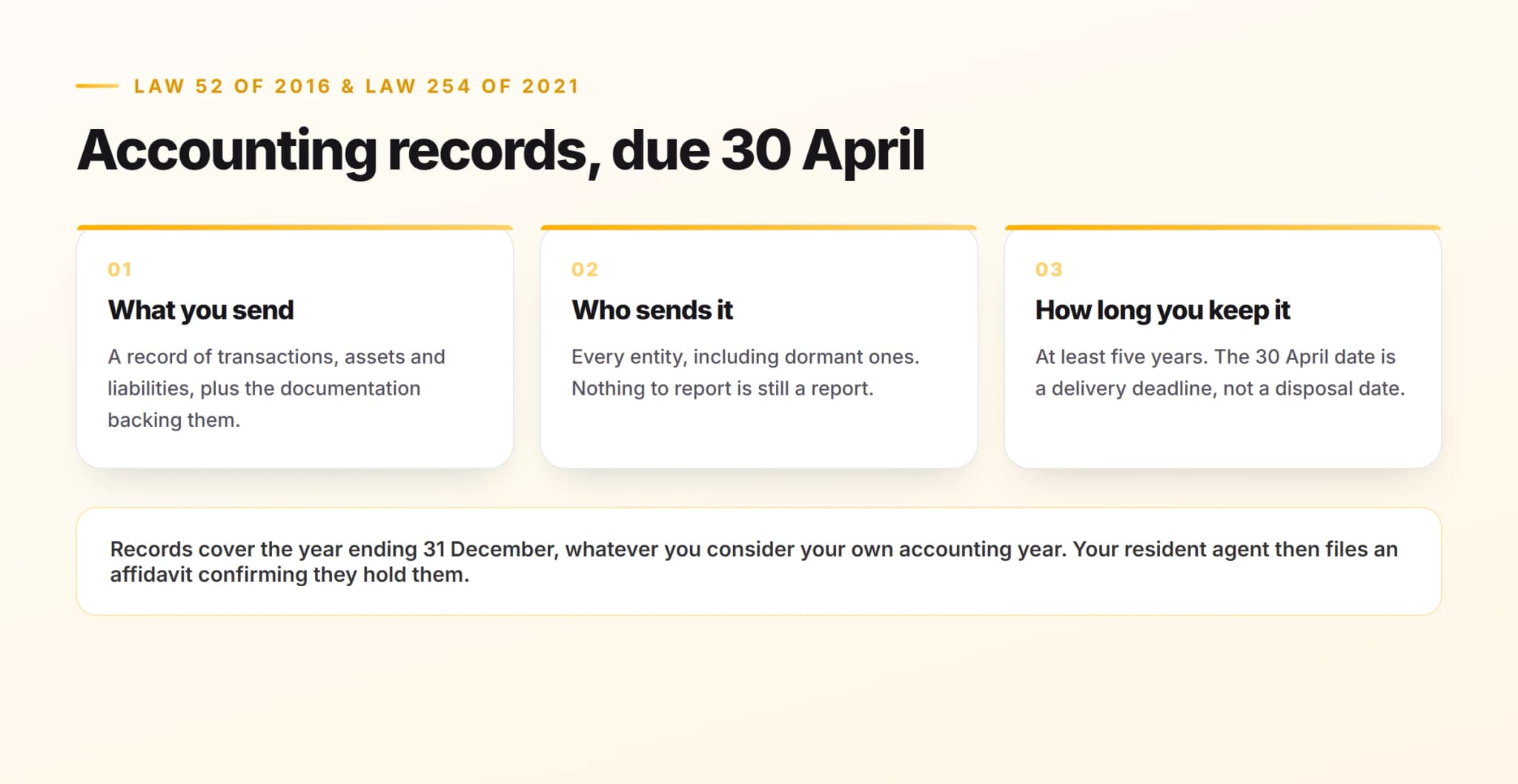
Law 52 of 2016 created the obligation and Law 254 of 2021 tightened it, adding the fixed April 30 date and the agent's affidavit. Both are published in Panama's Gaceta Oficial if you want the original text. Before 2021 the rule was vaguer and enforcement was thin. That era is over.
Accounting records here means what you would expect: a record of transactions, the assets and liabilities the entity holds, and documentation backing both. For a dormant holding company that can be a short statement showing no movement. For an active trading entity it is a proper ledger.
Three practical points matter more than the legal wording:
- You must retain the records for at least five years, so April 30 is a delivery deadline, not a disposal date.
- Records cover the year ending 31 December, regardless of what you consider your accounting year.
- A dormant company still files. Nothing to report is a report.
Owners running a Panama holding company sometimes assume a structure with no trading activity falls outside this. It does not. The entity exists, so the obligation exists.
What corporate records must you keep beyond the accounting file?
Panama corporations must maintain a share register and a minute book, and must keep at least three directors in place. Changes to directors, officers or the registered agent get recorded at the Public Registry when they happen, rather than waiting for an annual filing.
The three director minimum surprises people coming from jurisdictions where one person can hold the whole company. Panama wants three named directors, who can be any nationality and do not need to live in Panama. Directors and shareholders are separate roles, so owning the company and sitting on the board are not the same thing.
Two books matter:
- The share register, recording who holds shares and any transfers between them.
- The minute book, recording board and shareholder resolutions.
Neither gets filed publicly. Both need to exist and be current, because a bank running due diligence or a buyer running diligence on an acquisition will ask for them. Reconstructing five years of resolutions from memory the week before a deal closes is a genuinely bad experience.
Event driven updates are the ones people forget. Appointing a new director, removing an old one, changing your registered office or switching agents all trigger a Public Registry filing at the time it happens. Nothing about that waits for a year end, and a registry record that disagrees with reality causes problems the moment somebody checks.
Requirements differ slightly by structure, and the board rules are one of the practical differences between the two main vehicles, which we compare in Panama LLC vs corporation.
Who has to report beneficial owners under Law 129?
Every Panamanian legal entity reports its ultimate beneficial owners through its resident agent, into the Private and Unique System of Registration of Beneficial Owners created by Law 129 of 2020. The agent must register the details within fifteen business days of incorporation or of taking over as agent.
The register is private. It is not a public database like the UK's, and the information is not searchable by your competitors, journalists or anyone browsing the internet. Access sits with Panamanian authorities under defined circumstances.
What gets reported is the natural person behind the structure. Not the nominee, not the holding entity, the human being. If ownership passes through three companies in two jurisdictions, the chain gets followed to the person at the end of it.
The penalties land on the agent, between B/.1,000.00 and B/.5,000.00 for each entity that is not registered or kept current, with escalating daily fines on top for continued failure. Your agent is exposed here in a way you are not, which is why a good one will refuse to keep an entity on their books when the owner will not supply documents. Losing an agent is much worse than sending the passport copy.
Update the register whenever ownership changes. Selling shares, adding a shareholder, restructuring the group, all of it triggers a refresh. The obligation is continuous, not annual.
What else do you file if the company trades inside Panama?
Companies earning Panamanian source income take on a second layer: an Aviso de Operación commercial licence, annual income tax returns, and ITBMS registration once turnover passes B/.36,000.00 a year. Purely offshore entities skip all three under Panama's territorial system.
The commercial licence tax runs at 2% of the company's capital, with a floor of B/.100.00 and a ceiling of B/.60,000.00. Most small operating companies land near the floor.
Income tax returns are generally due by 31 March, with an extension to 30 April available on request. ITBMS, Panama's value added tax, is filed monthly once you cross the registration threshold.
Whether you fall into this layer at all comes down to where your income is generated, not where your company is registered. We unpack that distinction properly in our guide to the Panama territorial tax system, and it is worth reading before you assume you are outside the net. The rules also shifted for a narrow band of entities under the new substance regime, which we cover in is Panama still a tax haven.
What happens when you miss a Panama compliance deadline?
A late franchise tax payment adds a B/.50.00 surcharge. Three consecutive years unpaid and the Public Registry suspends the entity, which then needs all arrears cleared plus a B/.1,000.00 rehabilitation fine and B/.25.00 in registry fees to come back.
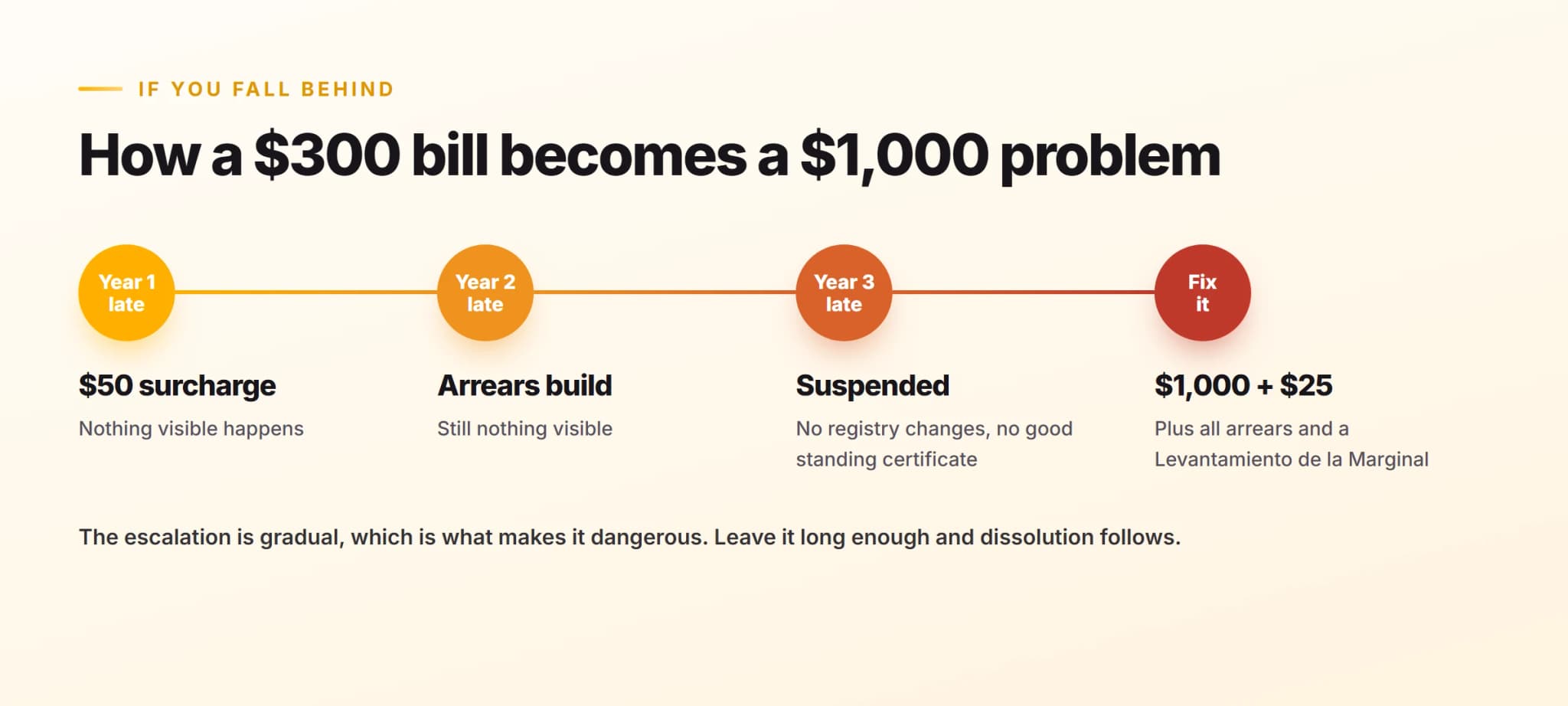
The escalation is gradual, which is exactly what makes it dangerous. Year one costs you fifty dollars and nothing appears to happen. Year two, still nothing visible. Year three, the entity stops functioning.
Suspension is worse than the fine suggests. A suspended company cannot make changes at the Public Registry, cannot obtain a certificate of good standing, and cannot complete most transactions that need proof it exists. Banks ask for that certificate constantly, so the practical effect is that your Panama bank account becomes very difficult to maintain or reopen.
Bringing a suspended entity back runs roughly like this:
- Calculate every unpaid franchise tax year plus accumulated surcharges.
- Pay the arrears in full through the DGI's e-Tax 2.0 platform.
- Pay the B/.1,000.00 rehabilitation fine and the B/.25.00 registry fee.
- Have your resident agent request the Levantamiento de la Marginal, the procedure that lifts the suspension note from your registry file.
- Obtain the rehabilitation resolution, then apply for a fresh certificate of good standing to confirm the entity is clean.
Leave an entity suspended long enough and dissolution follows. At that point you are not reviving a company, you are incorporating a new one and explaining the gap to a bank.
What does annual maintenance cost in total?
Budget roughly B/.550.00 to B/.1,100.00 a year for a straightforward offshore corporation. That covers the B/.300.00 franchise tax, B/.150.00 to B/.500.00 for the resident agent, and B/.100.00 to B/.300.00 for a registered office where it is charged separately.
| Item | Corporation | Foundation | Notes |
|---|---|---|---|
| Annual franchise tax | $300 | $400 | Fixed by the DGI, not revenue linked |
| Resident agent | $150 to $500 | $150 to $500 | Mandatory, must be a Panamanian lawyer or firm |
| Registered office | $100 to $300 | $100 to $300 | Often bundled with the agent fee |
| Accounting records support | Varies | Varies | Depends on activity level |
| Typical total | $550 to $1,100 | $650 to $1,200 | Before bookkeeping or tax filing fees |
Trading companies sit higher because the commercial licence tax, bookkeeping and tax returns stack on top. Our breakdown of what it costs to form a company in Panama covers the first year, where incorporation fees dominate and maintenance is the smaller number.
One thing worth saying plainly: maintenance is cheap relative to what the structure does. Owners who abandon an entity almost never do it because B/.300.00 was unaffordable. They do it because nobody sent a reminder.
What does the Panama compliance calendar look like?
Four dates carry most of the weight: 31 March for income tax returns, 30 April for accounting records, and either 15 July or 15 January for the franchise tax depending on your registration semester. Beneficial ownership updates run continuously rather than annually.
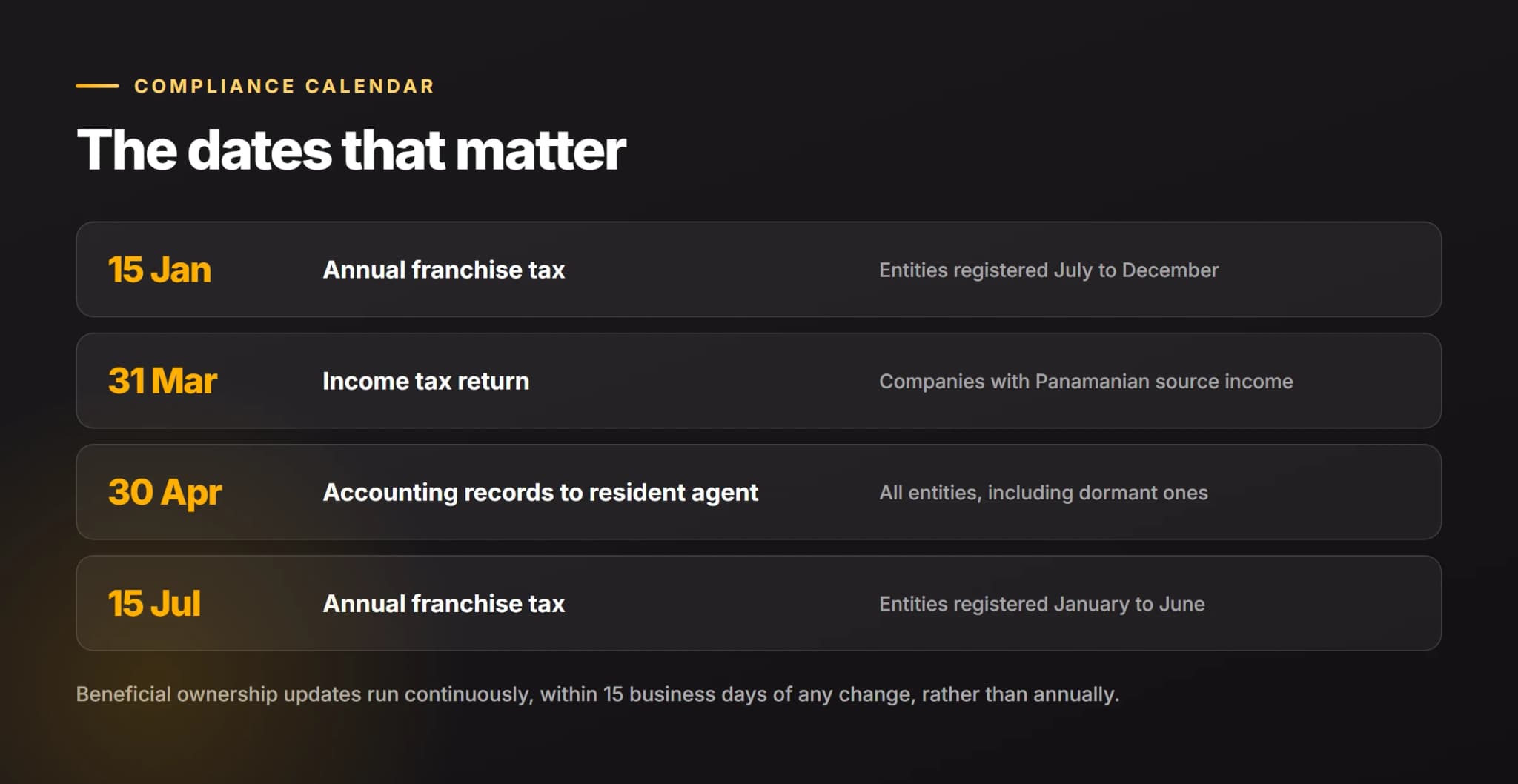
| Deadline | Obligation | Who it applies to |
|---|---|---|
| 15 January | Annual franchise tax | Entities registered July to December |
| 31 March | Income tax return | Companies with Panamanian source income |
| 30 April | Accounting records to resident agent | All entities, including dormant ones |
| 30 April | Income tax return, extended deadline | Companies that requested an extension |
| 15 July | Annual franchise tax | Entities registered January to June |
| Within 15 business days | Beneficial ownership registration or update | Triggered by incorporation, agent change or ownership change |
Put the two that apply to you in a calendar with a month of warning. The whole failure mode this guide describes starts with a date nobody was watching.
If you would rather not watch them yourself, that is what a compliance service is for. We keep the franchise tax paid, the records filed and the register current, and you get told before a deadline rather than after. Talk to our team if you want that handled.
FAQs
How much is the annual franchise tax for a Panama company?
Corporations pay B/.300.00 a year and private interest foundations pay B/.400.00. The amount is fixed and does not change with revenue, assets or activity, so a dormant company pays the same as a trading one. Late payment adds a B/.50.00 surcharge.
When is the Panama franchise tax due?
Your deadline depends on when the entity was registered. Companies registered between January and June pay by 15 July each year. Companies registered between July and December pay by 15 January. The date is set by your registration, not your fiscal year, and it never changes.
Does a dormant Panama company still have to file anything?
Yes. A dormant entity still pays the annual franchise tax, still needs a resident agent, and still owes accounting records by 30 April even if the answer is that nothing moved. Having no activity does not suspend the obligations, it only makes them quicker to satisfy.
Can I be my own resident agent in Panama?
No. Panamanian law requires the resident agent to be a Panamanian lawyer or law firm, so a foreign owner cannot fill the role personally. The agent carries legal responsibility for reporting your beneficial ownership details, which is why the position is restricted to licensed practitioners.
What happens if my Panama company is suspended?
Suspension follows three consecutive years of unpaid franchise tax. The company cannot make Public Registry changes or obtain a certificate of good standing, which blocks most banking and transactional activity. Reactivation requires paying all arrears plus a B/.1,000.00 fine and B/.25.00 in registry fees.
Is the Panama beneficial owners register public?
No. The system created by Law 129 of 2020 is private and is not searchable by the public, competitors or media. Your resident agent files the information and Panamanian authorities may access it under defined circumstances, but it is not an open database.
