

Table of Contents
If you own a Panamanian company, the question that matters is not what the corporate tax rate is but what reaches your account when the company pays you. Panama dividends tax is the answer, and it depends on three things you control. Where the profit was earned, whether the company operates inside Panama, and whether you take the profit out or leave it in.
Get those three right and an owner earning abroad through a Panama company can pay nothing on the dividend. Get them wrong and the company withholds 10 percent before you see a dollar, then pays a further charge on what it kept.
The guide below covers the rates and who withholds them, and the foreign-source rule that decides whether your company is in the tax at all.
Panama Dividends Tax Rates: What the Company Withholds When It Pays You
The company withholds the tax when it declares the distribution and remits it to the tax authority, and you receive the net. The rate is set by where the profit came from, not by where you live.
The 10 Percent and 5 Percent Rates
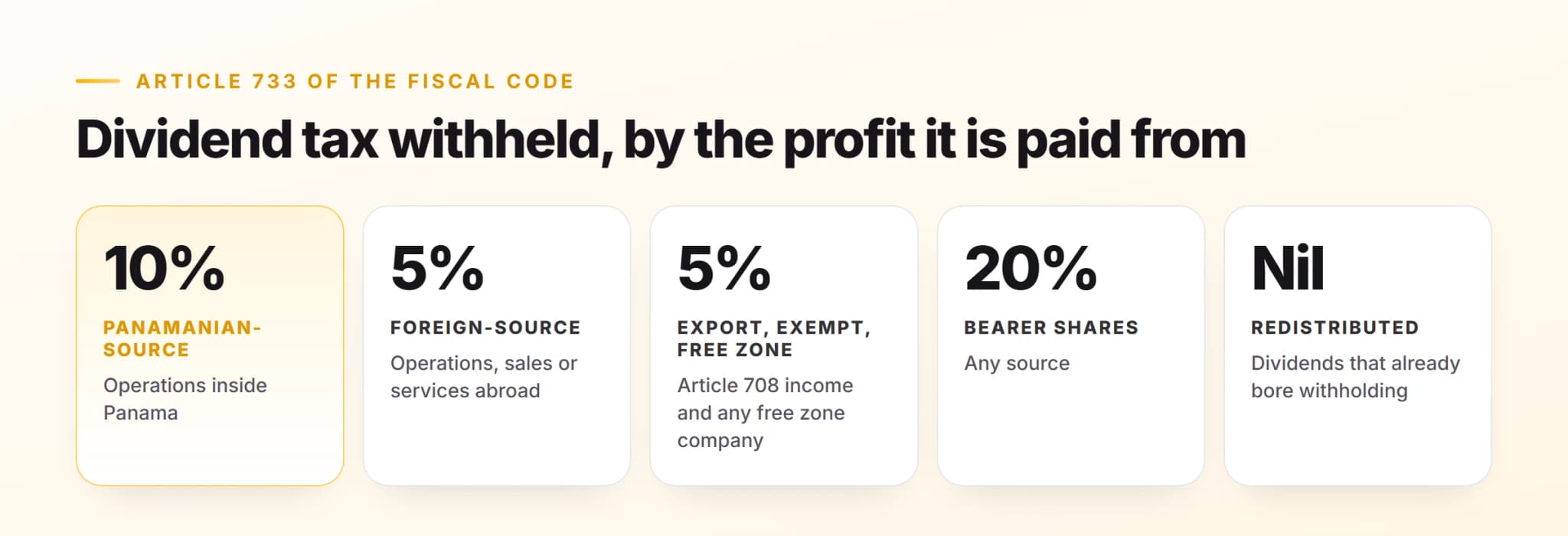
Under Article 733 of the Fiscal Code, a company withholds 10 percent on dividends paid out of Panamanian-source profit. The rate is 5 percent on dividends paid out of foreign-source, export or exempt profit. A company with both kinds of profit keeps them in separate accounts and applies each rate to the dividend drawn from each. The same rates apply whether you are resident in Panama or abroad, and a double tax treaty can reduce them where one exists with your country.
| Profit the dividend is paid from | Panama dividend tax withheld |
|---|---|
| Panamanian-source, from operations inside Panama | 10 percent |
| Foreign-source, from operations, sales or services outside Panama | 5 percent |
| Export operations and income exempt under Article 708 | 5 percent |
| Any source, paid by a company in the Colón Free Zone or another free zone | 5 percent |
| Any source, paid on bearer shares | 20 percent |
| Dividends the company received from another company that already withheld | Nil on redistribution |
Two things are treated as dividends even though no cash is paid to you as a dividend. A loan or advance from the company to a shareholder is taxed as a deemed dividend at 10 percent, or 20 percent on bearer shares. Capitalising retained profit into shares is treated as a distribution and taxed at the rate for the profit capitalised.
Free Zone Companies and Headquarters Companies
A company in the Colón Free Zone, Panamá Pacífico or any other free zone withholds 5 percent on every dividend, whatever the source of the profit. For a free zone company the profit is usually foreign-source anyway. A licensed multinational headquarters company under the SEM regime is exempt from dividend tax altogether, on local and foreign profit alike, as part of its regime. Everyone else follows the source rule above.
No Tax on the Dividend in Your Hands
Dividend tax Panama levies is collected once, at the company, and Panama does not tax the dividend again when you receive it. There is no personal income tax on dividends that have borne the withholding, and no further Panamanian filing by you as shareholder. What your own country of residence does with the dividend is a separate question, and the section on foreign-source income returns to it.
Panama Dividend Withholding Tax on Foreign-Source Income: When Your Company Is Outside the Tax
Most owners who form a Panama company earn their profit outside Panama. Whether that profit bears any dividend tax turns on one question, whether the company has a presence in Panama that requires a notice of operations.
The Notice of Operations Test
Panama dividend withholding tax on foreign-source profit applies only to a company that falls into one of five categories. A company outside all five is outside the dividend tax.
- A company that needs a notice of operations to do business in Panama
- A company that needs an operation key for the Colón Free Zone
- A company established in a fuel free zone
- A company established in another free or special zone
- A company that produces Panamanian-source taxable income
- A company with an office, staff or customers in Panama needs a notice of operations and withholds 5 percent on foreign-source dividends
- A company that operates entirely abroad, with no Panamanian office, no local sales and no notice of operations, withholds nothing on foreign-source dividends
- A company that earns both, from Panama and abroad, is inside the tax and applies 10 percent to one pool and 5 percent to the other
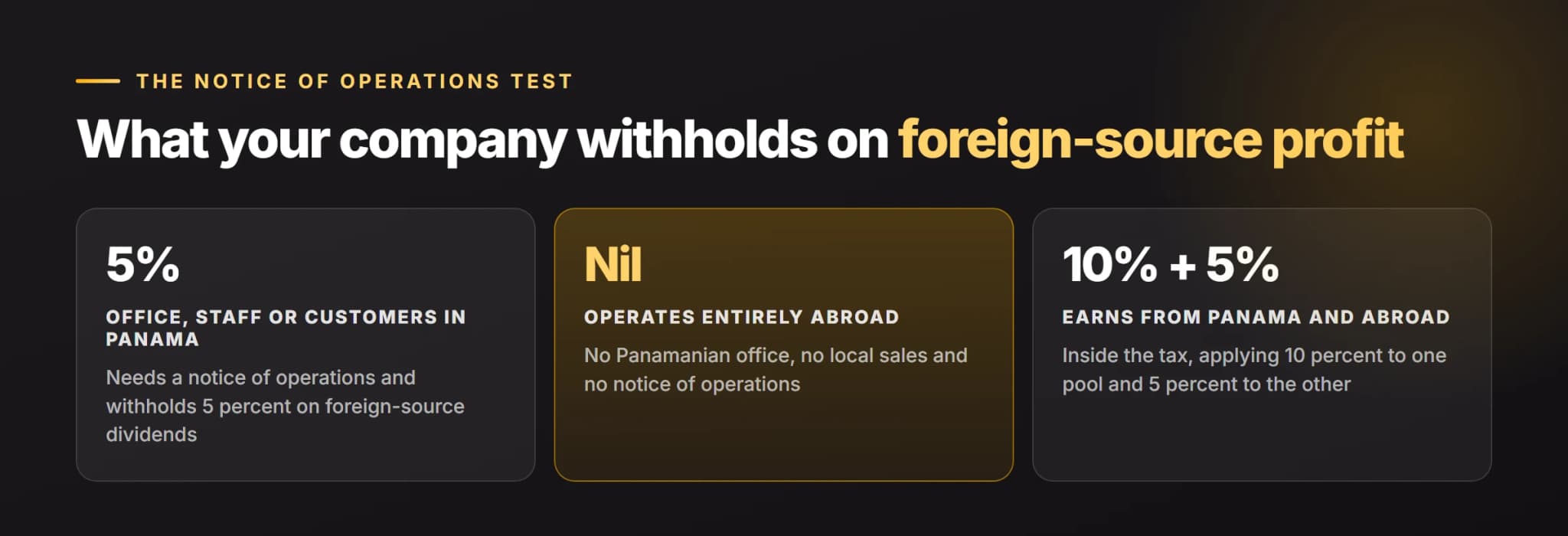
The practical test is simple. If your company invoices from Panama, employs in Panama or sells to Panama, it holds a notice of operations and the 5 percent applies to its foreign profit. If it does none of those and its work, sales and clients are elsewhere, it holds no notice and the dividend leaves Panama untaxed.
What Counts as Foreign-Source Profit
Panama's territorial system treats income from operations, services and sales carried out outside the country as foreign-source. Article 694 of the Fiscal Code lists the activities that stay foreign-source even when administered from Panama. Directing from a Panamanian office the sale of goods that never enter Panama is foreign-source. So is invoicing from Panama for services performed abroad, and so is receiving dividends from a foreign company. That profit pays no corporate income tax, and its dividend pays 5 percent or nothing under the test above.
| Activity | Source | Corporate tax | Dividend tax if the company holds a notice of operations |
|---|---|---|---|
| Consulting delivered to clients abroad | Foreign | Nil | 5 percent |
| Goods bought abroad and sold abroad, invoiced from Panama | Foreign | Nil | 5 percent |
| Dividends from a subsidiary in another country | Foreign | Nil | 5 percent, or nil if the subsidiary withheld |
| Services delivered to clients in Panama | Panamanian | 25 percent | 10 percent |
| Goods sold into Panama | Panamanian | 25 percent | 10 percent |
Your Home Country Is the Other Half
Panama's rate is the first tax on the dividend, not the last. Your country of residence taxes what you receive under its own rules, with or without a credit for the Panamanian withholding. Panama has treaties with a limited number of countries, including Mexico, Spain and the United Kingdom. Where one applies, the withholding rate can fall and the credit is assured. One rule runs the other way. Where a special law exempts a dividend from Panamanian withholding, the exemption does not apply if you can credit the Panamanian tax in your country of residence. Where none applies, the 5 or 10 percent is a cost your home country's rules decide whether to relieve. Company Formation in Panama structures the company with your residence in view, because the right Panamanian answer depends on the country the dividend is going to.
Panama Dividends Withholding Tax on Retained Profit: The Complementary Tax and How the Withholding Is Paid
Leaving profit in the company does not avoid the tax. Panama charges an advance on dividends you have not yet paid, and the withholding on the dividends you do pay runs on a short deadline.
The Complementary Tax on Undistributed Profit
If the company distributes less than 40 percent of its Panamanian-source net profit after income tax in a year, a complementary tax applies. The rate is 10 percent on the shortfall. The same applies where it distributes less than 20 percent of its foreign-source or exempt net profit. On a company that distributes nothing, that is 4 percent of Panamanian-source profit and 2 percent of foreign-source profit for the year. The complementary tax is an advance, credited against the dividend tax when the profit is eventually distributed, so the cost is timing rather than an additional layer.
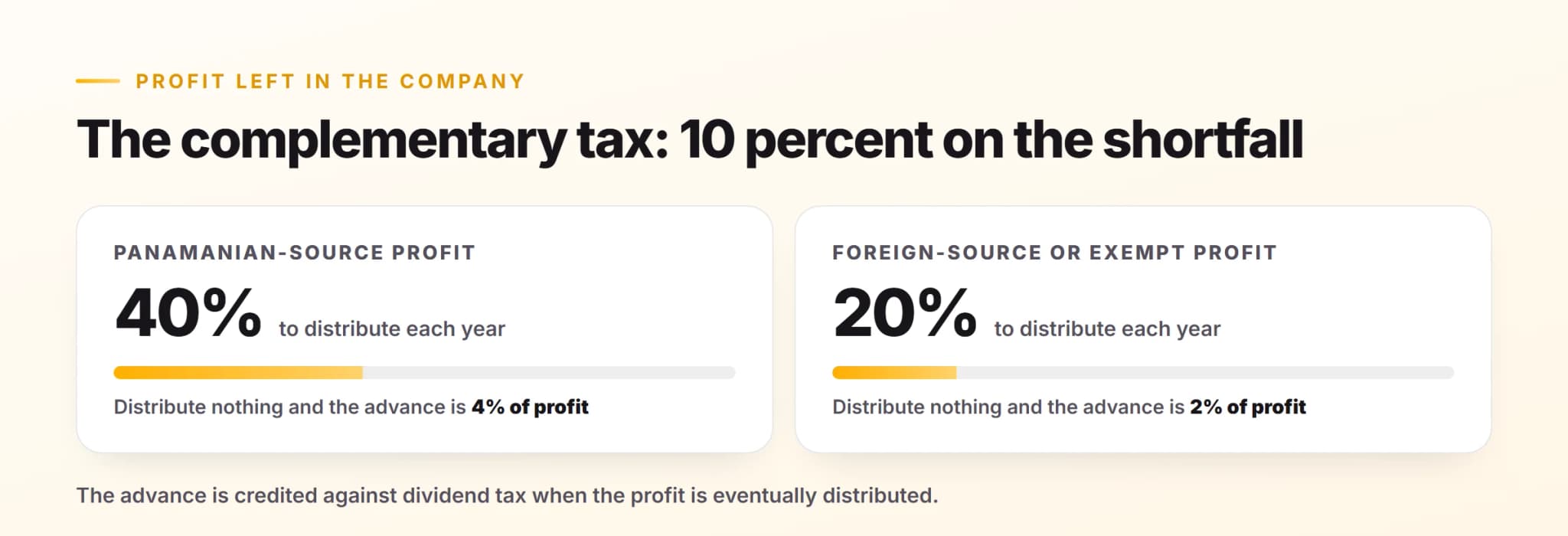
- Panamanian-source profit: distribute 40 percent, or pay 10 percent on the shortfall
- Foreign-source or exempt profit: distribute 20 percent, or pay 10 percent on the shortfall
- A company outside the dividend tax under the notice of operations test is outside the complementary tax as well
- The complementary tax paid is credited against dividend tax on later distributions
A company that meets the distribution threshold in a year has to distribute retained profit from earlier years taxed at 10 or 20 percent first. Only then can it distribute profit taxed at 5 percent. The ordering rule stops a company paying out its low-rate profit first while its high-rate profit sits untaxed.
How the Withholding Is Paid
The company withholds the dividend tax on the date it declares or pays the distribution and remits it to the Dirección General de Ingresos with the corresponding return. The obligation is the company's, and a company that pays a dividend gross and fails to withhold is liable for the tax, the surcharges and the interest itself. Your dividend certificate shows the gross amount, the rate and the tax withheld, and it is the document your home country's return relies on for any credit.
| Event | What the company does |
|---|---|
| Board declares a dividend | Identifies the profit pool it is paid from and the rate |
| Payment date | Withholds 10, 5 or 20 percent and pays you the net |
| Filing | Remits the withholding to the DGI on the dividend tax return within the statutory period |
| Year-end | Tests distributions against the 40 and 20 percent thresholds and pays complementary tax on any shortfall |
| Records | Keeps separate retained earnings accounts by source, so each dividend is traced to its pool |
Planning the Distribution
The decision each year is how much to distribute from each pool. Meeting the thresholds above avoids the complementary tax and its cash-flow cost, and distributing everything from a company outside the tax costs nothing at Panama's end. The timing then turns on your home country's year and rate rather than on Panama's. Company Formation in Panama sets up the retained earnings accounts by source at formation and models the distribution each year. The withholding is then right, the complementary tax is avoided where it can be, and your dividend certificate supports the credit at home.
Settle Where the Profit Is Earned Before You Decide How to Take It
Panama dividend tax comes down to the source of the profit and the presence of the company, and both are decided before the first dividend.
- The company withholds 10 percent on dividends from Panamanian-source profit and 5 percent on dividends from foreign-source, export or exempt profit
- A company that operates entirely outside Panama, with no notice of operations, pays no dividend tax on its foreign-source profit
- Free zone companies withhold 5 percent on everything, and bearer shares carry 20 percent
- Retaining profit triggers the complementary tax, an advance of 10 percent on the shortfall below 40 or 20 percent of net profit
- Your home country taxes the dividend it receives, with a credit where a treaty or its own rules allow one
Tell us where your clients are, where your team sits and where you are tax resident. Company Formation in Panama will tell you which pool your profit falls into and whether the company needs a notice of operations. You then know what a distribution will cost you at both ends.
Frequently Asked Questions
My company has no office in Panama and all its clients are abroad. Do I pay Panama dividend tax when I pay myself?
No. A company with no notice of operations, no free zone presence and no Panamanian-source income is outside the dividend tax. Its foreign-source profit is outside corporate income tax as well. The dividend leaves Panama untaxed. What you pay is decided by your country of residence.
If I take money out as a loan instead of a dividend, do I avoid the withholding?
No. A loan or advance from the company to a shareholder is a deemed dividend, taxed at 10 percent, or 20 percent on bearer shares. Repaying the loan later does not recover the tax. A dividend and a loan cost the same at Panama's end, and the dividend is the cleaner record for your home country.
Is the 5 percent rate on foreign-source dividends a final tax?
In Panama, yes. There is no further Panamanian tax on the dividend in your hands. Whether it is final overall depends on your country of residence. Your country taxes the dividend under its own rules and gives a credit for the 5 percent where a treaty or its domestic law provides one.
What happens if the company never distributes and never pays the complementary tax?
The complementary tax is assessed on the return with surcharges and interest, and the company's tax clearance is refused until it is paid. The tax is an advance, so it is credited when dividends are eventually paid, but the surcharges for not paying it on time are not. Distributing 40 or 20 percent each year, or paying the advance on time, keeps the company clear.
Does a foreign shareholder pay a higher rate than a Panamanian one?
No. The withholding rate is set by the source of the profit and the type of share, not by the residence of the shareholder. A foreign shareholder receives the same net dividend as a Panamanian one, and receives more where a treaty between Panama and their country reduces the rate.
Disclaimer: The information provided in this blog is for general informational purposes only. For professional assistance and advice, please contact experts.
