

Table of Contents
If you are launching an online casino or sportsbook for players outside Panama, the Panama gaming license gives you a national regulator, a fixed fee and a fixed tax. The Junta de Control de Juegos grants it to a Panamanian corporation that passes its ownership, financial and technical review. You then pay $40,000 on approval, $20,000 a year and 10 percent of gross gaming revenue, with no corporate income tax on foreign-source revenue on top.
The guide below covers what the licence costs and what the Board requires of your company, its owners and its platform.
What a Panama Gaming License Is and What It Costs
The Junta de Control de Juegos, the Gaming Control Board under the Ministry of Economy and Finance, regulates every form of gambling in Panama. Its online licence, issued under Resolution 65 of 2002, covers casino games, sports betting, bingo and skill games offered to players outside the country.
The Licence and Who Issues It
A Panama gambling license for online operations is held by a Panamanian corporation, a sociedad anónima, that the Board has approved. The licence authorises the company to operate the gaming categories named in it from servers anywhere in the world, with players outside Panama. Once you hold it, the Board supervises you through monthly financial reporting, periodic compliance reporting, an annual audit and technical re-certification when your game catalogue changes.
- Regulator: Junta de Control de Juegos, Ministry of Economy and Finance
- Legal basis: Resolution 65 of 2002 for online gaming, Law 23 of 2015 for anti-money-laundering
- Holder: a Panamanian corporation approved by the Board
- Categories: online casino, sportsbook, bingo and skill games
- Players: outside Panama, with the licensee responsible for the laws of each market it serves
Fees, Tax and Term
The cost of a gaming license Panama issues has three parts, the state fees, the tax on your revenue and the guarantee. The fees are fixed by decree. The tax is 10 percent of gross gaming revenue, meaning bets less winnings paid, and is paid monthly. Revenue from players outside Panama is foreign-source, so no corporate income tax applies to it beyond the gaming levy.
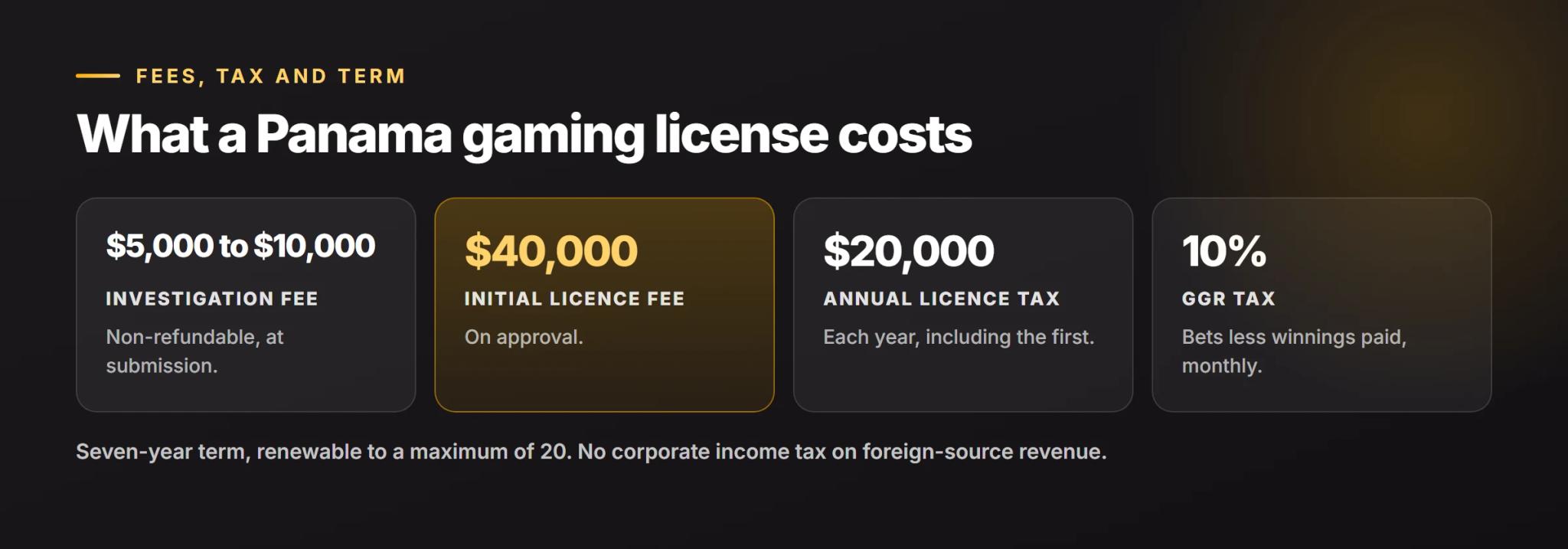
| Item | Amount | When |
|---|---|---|
| Investigation and due diligence fee | $5,000 to $10,000, non-refundable | At submission |
| Initial licence fee | $40,000 | On approval |
| Annual licence tax | $20,000 | Each year, including the first |
| Gross gaming revenue tax | 10 percent of GGR | Monthly |
| Financial guarantee | Set by the Board on the operation's scale | Before the licence issues |
| Corporate formation, compliance program and legal work | $15,000 to $40,000 depending on the structure | Before and during the application |
| Term | Seven years, renewable to a maximum of 20 |
Your first-year budget for a single-operator licence therefore runs from about $80,000 to $110,000 before the guarantee and the platform. After that it is $20,000 a year and the 10 percent levy.
Where the Licence Works and Where It Does Not
A Panama gambling license lets you operate lawfully from Panama and satisfies payment providers, game suppliers and platform vendors that ask for a regulated licence. The licence does not give you the right to take players in a country that requires its own local licence, and several of the largest markets do. If you serve Latin America, Asia and markets with no domestic regime, the Panama online gaming license is your primary authorisation. You add local licences where a market requires one. Company Formation in Panama maps your target markets against that line before the application is filed, because the licence is worth what the markets you serve accept it for.
Panama Gambling License Requirements: The Company, the People and the Platform
The Board licenses a company, and it looks through the company to the people who own and run it and to the platform they will run. Each of the three has its own requirements.
The Company
The applicant is a Panamanian sociedad anónima, formed with a resident agent, a registered office and a board of directors. The company holds the notice of operations that lets it do business from Panama. Before it applies, the company registers with the Financial Analysis Unit under Law 23 of 2015 as a reporting entity and appoints a compliance officer. A written anti-money-laundering and know-your-customer program is adopted at the same time. The Board expects the program to match the standard of a financial institution, with customer identification, transaction monitoring, suspicious activity reporting and record retention.
- Sociedad anónima with resident agent, registered office and directors
- Notice of operations for a Panamanian business presence
- Registration with the Financial Analysis Unit as a reporting entity
- Named compliance officer and a written AML and KYC program
- Financial statements or a capitalisation plan showing the funds to operate
The Owners and Directors
Every shareholder, ultimate beneficial owner, director and key manager in your company is investigated by the Board before the licence is granted. The investigation fee funds that review, and it covers identity, criminal record, source of funds and gaming or financial history. A person with a conviction for fraud, money laundering or a gaming offence disqualifies the application, and an owner whose source of funds cannot be documented does the same.
| Person | What the Board reviews |
|---|---|
| Shareholders and ultimate beneficial owners | Identity, source of the funds invested, criminal and regulatory history |
| Directors | Identity, criminal record, professional history |
| Compliance officer | Qualifications and experience in AML compliance |
| Key managers | Gaming industry experience and criminal record |
The Platform
Your gaming platform is certified by an approved testing laboratory before the licence issues. Certification covers the random number generator, the game engine, the fairness of the published return-to-player figures, and the security of player data and funds. Servers can be located outside Panama, but the Board requires access to the data it needs for supervision. Player funds are held in accounts segregated from your own. A change to the game catalogue after licensing triggers re-certification of what changed.
- Random number generator and game engine certified by an approved laboratory
- Player funds held in segregated accounts
- Data retained and accessible to the Board for supervision
- Responsible gaming tools in place, including limits and self-exclusion
- Re-certification when games or providers are added
Law 527 of 2026: The New Player Protection Duties
Panama enacted Law 527 on May 23, 2026, and the Executive has six months from its publication to implement it. The law gives the Board power to block unlicensed sites, applications and domains, with telecom providers required to comply within five days under fines of up to $1 million. For licensees it adds duties the platform has to be built to meet. The law also creates a problem-gambling fund for the Institute of Mental Health, financed from a share of the amounts operators pay to the Treasury.
- Biometric identity and age verification for every user, to keep minors off the platform
- User-set limits on spending and time, with automatic notifications when the platform detects suspicious behaviour
- Restrictions on advertising through media, social networks and sport, including promotion by public figures and influencers
- Real-time supervision by the Board, with fines, licence suspension and criminal referral for serious breaches
- A contribution to the problem-gambling fund, set by the law and its implementing regulation
An application filed now is prepared to the Law 527 standard rather than the 2002 one. The Board will supervise the licensee under it from the day the implementing regulation takes effect.
How Our Team Takes a Panama Gaming License Application From Formation to Grant
The application succeeds on the completeness of the file. Our team prepares yours in four stages, forms the company that holds the licence, and manages the Board's review through to the certificate. You approve each filing before it goes.
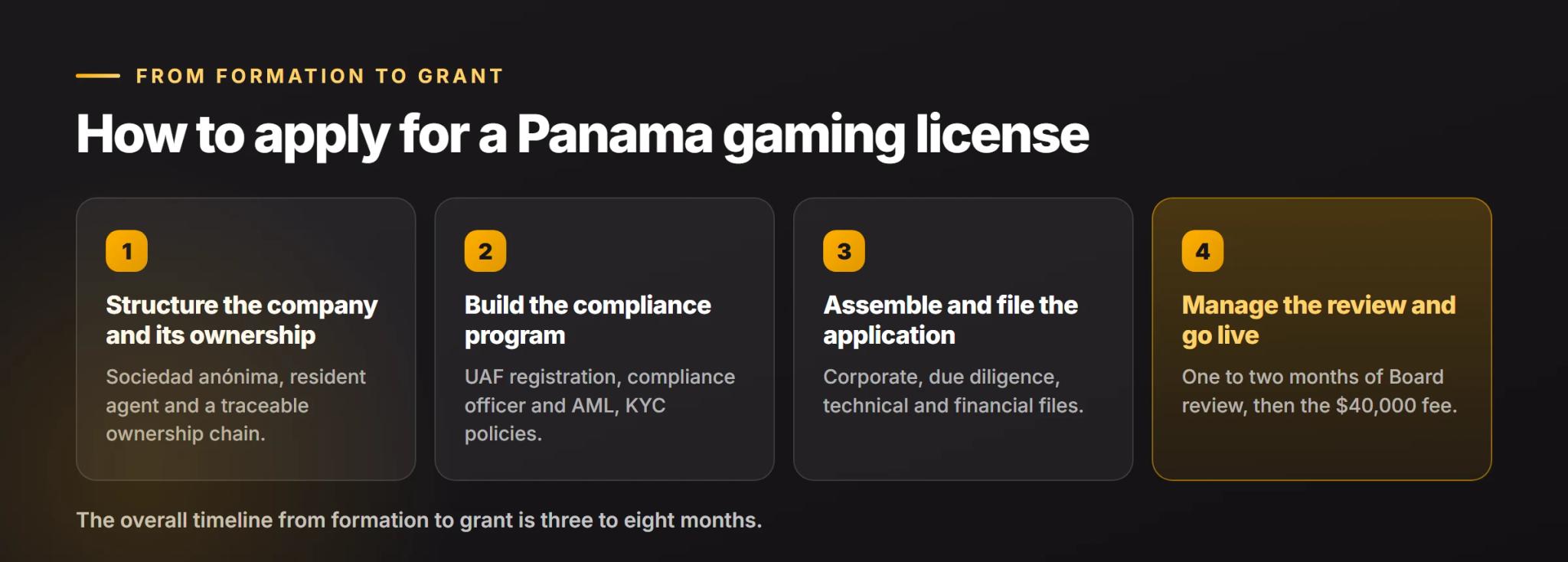
Stage 1: Structure the Company and Its Ownership
We form the sociedad anónima that will hold the licence, with the resident agent, the registered office and the board the application requires, and obtain the notice of operations. The company formation runs to the same standard as any Panamanian corporation we form, with the licence file added on top. Where you own the operator through a foreign group, we set the ownership chain so that every beneficial owner can be identified and documented to the Board. An opaque holding above the Panamanian company is the most common reason a file stalls in review.
Stage 2: Build the Compliance Program and Register the Company
We register the company with the Financial Analysis Unit as a reporting entity under Law 23 of 2015 and appoint the compliance officer. The anti-money-laundering, know-your-customer and responsible gaming policies are drafted to the Board's standard. The financial statements or capitalisation plan are prepared to show the funds the operation needs. The financial guarantee is arranged so it can be lodged the day the Board approves.
Stage 3: Assemble and File the Application
We assemble your application package and file it with the Board with the investigation fee. The package includes the corporate documents, the business plan, the owner and director due diligence files, the compliance program, the platform certification and the financial evidence. Each document is prepared to the Board's format, because a file the Board has to query is a file that waits.
| Component | What we prepare |
|---|---|
| Corporate file | Articles, register of directors and shareholders, notice of operations, UAF registration |
| Business plan | Markets, games, payment methods, projected GGR and staffing |
| Due diligence file | Certified identity, criminal record and source of funds for every owner, director and key manager |
| Compliance program | AML, KYC, responsible gaming and record-retention policies with the compliance officer named |
| Technical file | Platform certification from an approved laboratory, hosting and data access arrangements |
| Financial file | Statements or capitalisation plan, and the guarantee ready to lodge |
Stage 4: Manage the Review and Take the Licence Live
The Board's investigation of a complete file runs one to two months, and a file with queries runs longer. The overall timeline from formation to grant is three to eight months depending on your structure. The Law 527 duties are built into the platform file before it is submitted. We answer the Board's questions as they arise, lodge the guarantee and pay the $40,000 fee on approval, and collect the licence. We then set up the monthly gross gaming revenue return and payment, the periodic compliance reporting and the annual audit, so the licence is maintained from its first month.
Budget the Licence and the Compliance Program Together, Then Apply
A Panama gaming license is a fixed-cost, fixed-tax authorisation from a national regulator. The file that wins it is the one that answers every question before the Board asks.
- The Junta de Control de Juegos issues the online licence under Resolution 65 of 2002 to a Panamanian corporation, for seven years renewable to 20
- The cost is $40,000 on approval, $20,000 a year after, a due diligence fee at filing, a financial guarantee, and 10 percent of gross gaming revenue paid monthly
- The Board investigates every owner, director and key manager, and requires a compliance program to the standard of Law 23 of 2015
- The platform is certified by an approved laboratory before grant, re-certified when the catalogue changes, and built to the biometric, limit and advertising duties of Law 527 of 2026
- The licence authorises operations from Panama for players abroad, and the operator adds local licences where a market requires one
Tell us the games you will offer, the markets you will serve and who will own the company. Company Formation in Panama will confirm the licence fits, cost the application to the dollar, and take it from the corporation to the certificate.
Frequently Asked Questions
Can a foreign company apply for the licence directly, or does it need a Panamanian subsidiary?
The licensee has to be a Panamanian corporation. A foreign operator forms a Panamanian sociedad anónima to hold the licence, with the foreign company or its owners as shareholders. Every beneficial owner above that company is investigated, so the ownership chain has to be one the Board can trace.
Do my servers have to be in Panama?
No. The Board permits servers outside Panama. What it requires is access to the operational and financial data it needs for supervision, and segregation of player funds from the operator's own. Most licensees host in a data centre chosen for their markets and give the Board the access it requires.
Is the 10 percent tax charged on revenue or on profit?
On gross gaming revenue, which is total bets less winnings paid to players, before operating costs. The tax is paid monthly. Because the revenue comes from players outside Panama, it is foreign-source and no corporate income tax applies on top. That is what makes your effective rate low as a foreign-facing operator.
Can I add sports betting to a casino licence later?
Yes, by application to the Board for the additional category, with the platform certification extended to cover it. The licence names the categories it authorises, and a new category is an amendment rather than a new licence. Adding games within an existing category triggers re-certification of the games rather than an amendment.
What happens at renewal after seven years?
The licensee applies for renewal before the term ends, with updated due diligence on owners and directors, current financial statements and a clean compliance record. Renewals can extend the licence to a maximum of 20 years in total. A licensee that has paid its fees and taxes and filed its reports on time renews on its record.
Disclaimer: The information provided in this blog is for general informational purposes only. For professional assistance and advice, please contact experts.
