

Table of Contents
Ask almost anyone about the best offshore jurisdiction, and one name comes up before all others. The British Virgin Islands. It has become the default choice for international incorporation, much like Wyoming is for LLCs inside the United States. The BVI has its place, but it is overmarketed and overpromoted in many cases. There are situations where other jurisdictions, particularly the Republic of Panama, hold advantages the BVI cannot and will not have. This guide covers the real advantages of BVI companies, their disadvantages, and how a Panama SA compares to a BVI limited company.
Panama vs BVI: Quick Comparison
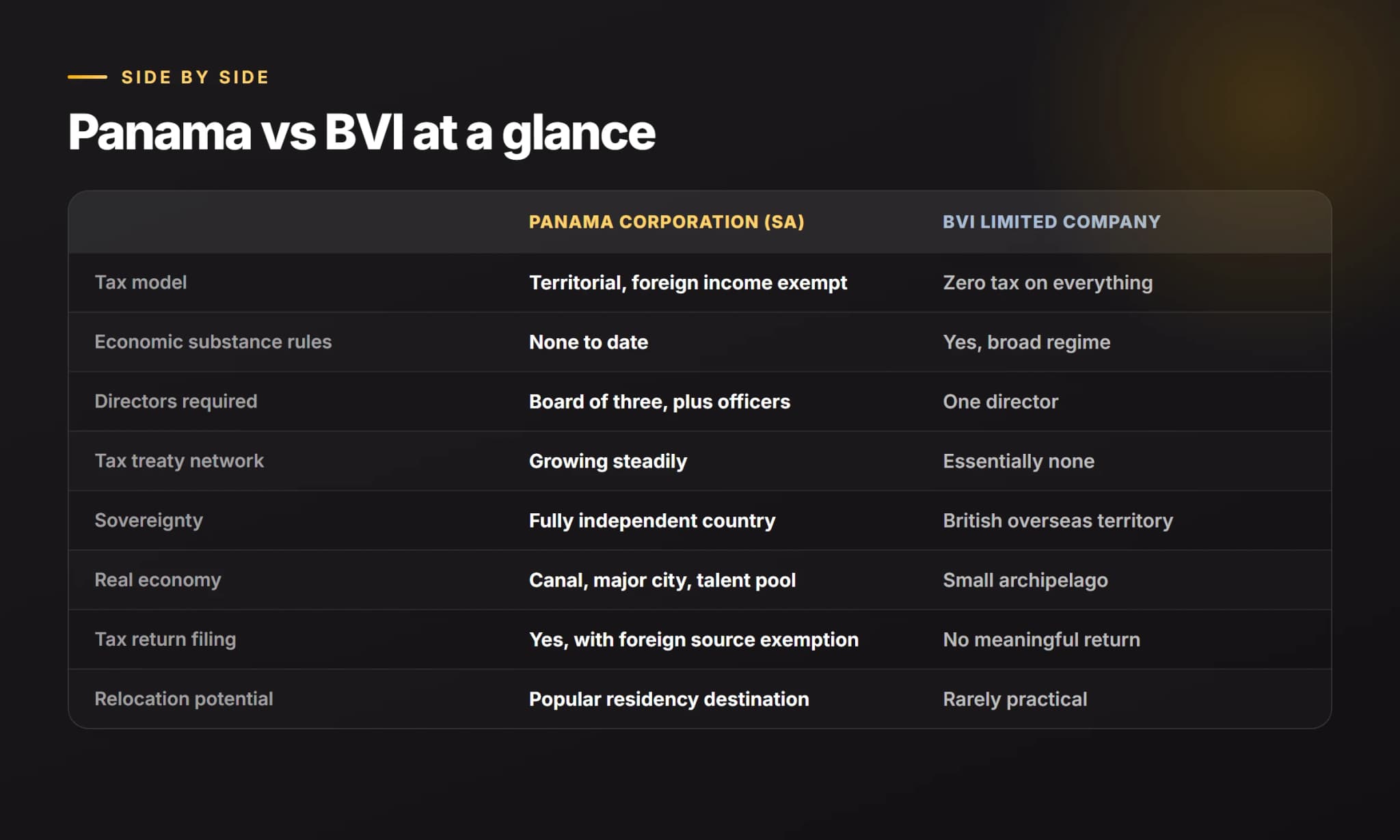
| Factor | BVI Limited Company | Panama Corporation (SA) |
|---|---|---|
| Formation speed | Very fast | Fast |
| Tax model | Zero tax on everything | Territorial; foreign income exempt |
| Directors required | One director | Board of three, plus officers |
| Economic substance rules | Yes, broad regime | None to date |
| Tax treaty network | Essentially none | Growing steadily |
| Sovereignty | British overseas territory | Fully independent country |
| Real economy | Small archipelago, limited market | Canal, major city, large talent pool |
| Tax return filing | No meaningful return | Yes, with foreign source exemption |
| Reputation | Asset holding and tax optimisation | Friendly to operating businesses |
| Relocation potential | Rarely practical | Popular residency destination |
Why the BVI Is the Default Choice
Tax advisors handling complex international situations see the same pattern daily. Clients from the United States, Canada, Australia, and the United Kingdom arrive with the decision already made.
- Prospective clients ask directly how much a BVI company will cost.
- They ask how quickly a BVI company can be set up.
- Almost nobody asks whether the BVI actually suits their situation.
- The BVI has become the go-to default for international business, exactly as Wyoming is the default for US LLCs.
A default choice made without analysis is still a choice, and it deserves scrutiny. Before you request a BVI company, you should understand exactly what you are buying. The sections below give you that full picture.
Advantages of a BVI Company
The BVI did not become the default by accident. It earns its popularity through several genuine strengths.
1. Fast Formation
Speed is the first advantage. The process involves minimal friction, and formation moves quickly from request to completion.
- You go in and request the company.
- Formation is usually completed very promptly.
- No complicated preliminary steps slow you down.
2. Flexible Governance
Governance flexibility is the second major benefit. The structure closely resembles a US LLC. In an LLC, the owners are called members, and those members can elect a manager. One manager can then do everything. A BVI company works on the same logic.
- Shareholders own the company and elect a single director.
- That one director can manage the entire company alone.
- Nothing more is required by law.
- You can add complexity, but only if you want it for a particular reason.
3. Strong Brand Recognition
The third advantage is brand power. The BVI is the incumbent. It has established itself as the recognised name for international companies, and that recognition carries practical weight. In certain international offshore circles, the brand alone opens doors for you. Because so many people choose the BVI, banks and platforms have grown comfortable with it.
- Your BVI company can access banking platforms relatively easily.
- Certain banks feel very comfortable with BVI wealth holding structures.
- Swiss banks in particular readily accept BVI entities.
- A BVI company that simply manages an investment portfolio faces little resistance.
Panama entities clear the same hurdles once the paperwork is in order, and we walk through what banks ask for in our guide to opening a bank account in Panama.
4. Low Setup Cost
Price is the fourth strength. Compare the cost of a BVI company with its neighbour, the Cayman Islands, and the difference is dramatic. A BVI company costs a fraction of what a Cayman Islands company costs to set up. Cayman entities rank among the most expensive offshore structures you can request, and formation firms handle them far less often than Panama corporations or BVI companies. The BVI wins clearly on cost.
For the Panama side of that comparison, we break the numbers down in how much it costs to form a company in Panama.
5. Zero Tax and Asset Protection
The BVI is a pure zero tax jurisdiction. That simplicity is attractive, and many applicants seek out exactly these advantages.
- No tax on income.
- No tax on capital gains.
- No tax on royalty income.
- No tax on anything else.
- Strong privacy protections.
- A higher degree of asset protection.
Disadvantages of a BVI Company
Weigh the following drawbacks carefully before you request a BVI company. Three problems stand out, and the first is the most important issue in modern international structuring.
1. Lack of Economic Substance
Substance over form is the principle that your legal structure must reflect your real economic activity. A sound structure should always follow the economic reality of your business operations, never the reverse. Measured against that standard, the BVI is weak.
The reason is geography and economics. The BVI is a very small archipelago and a British overseas territory. The domestic economy is quite limited. Only a handful of company owners can truly justify a link to the BVI. Those exceptions genuinely established offices there. They run hedge funds, insurance companies, or financial activities such as banking. In the vast majority of cases, people with BVI companies have no true link to the islands at all.
This gap between structure and reality carries real consequences. Substance over form now drives how authorities assess every offshore entity.
- Banks, regulators, and government authorities expect your structure to make sense.
- You cannot say you chose a jurisdiction because taxes were zero.
- You cannot say you chose it because incorporation was simple.
- There must be a reason genuinely rooted in business purposes.
- Getting tax advantages as a consequence of business logic is fine.
- It cannot work the other way around.
- Adapting your business artificially to a jurisdiction for tax reasons is exactly what authorities challenge.
This is where the BVI case really starts to crack.
2. Economic Substance Requirements
The second weakness is the economic substance regime administered by the BVI International Tax Authority. These rules require certain companies to prove real activity happens inside the territory. Compliance can be outsourced and handled cost-effectively, but it remains a permanent, recurring obligation. Jurisdictions like Panama impose no such requirements, which makes the burden harder to justify.
These requirements are also broader than most people realise. The regime affects your company if it is involved in any of the following activities.
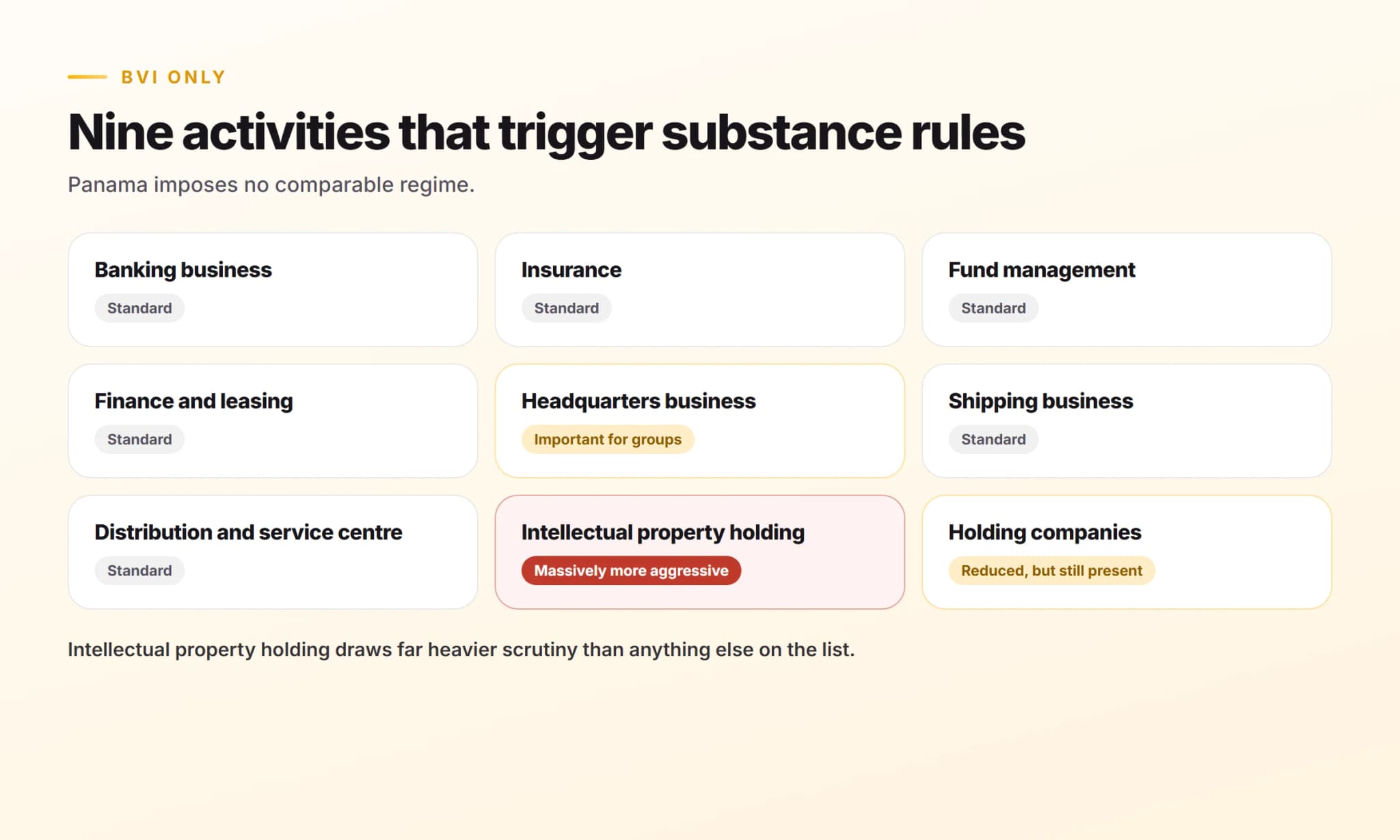
| Activity | What It Covers | Scrutiny Level |
|---|---|---|
| Banking business | Any involvement in banking | Standard |
| Insurance | Insurance operations | Standard |
| Fund management | Managing investment funds | Standard |
| Finance and leasing | Lending and leasing businesses | Standard |
| Headquarters business | Running a multi-jurisdictional, multi-entity group | Important for groups |
| Shipping business | Maritime operations | Standard |
| Distribution and service centre | Buying or selling goods or services with affiliated companies, sister companies, or subsidiaries | Standard |
| Intellectual property holding | Holding patents, trademarks, or copyrights | Massively more aggressive |
| Holding companies | Earning capital gains and dividends from other companies | Reduced, but still present |
An intellectual property holding triggers far more aggressive substance requirements and scrutiny than anything else on the list. If you want your BVI company to hold patents, trademarks, or copyrights, expect close examination. Pure holding companies sit at the other end. They can face reduced requirements, but the obligations are still there. Holding companies are also one of the most popular uses for BVI entities, so this catches many owners by surprise. Owners weighing the same function in Panama can compare the mechanics in our guide to setting up a Panama holding company.
- The list is very, very broad.
- If your BVI company genuinely provides services only to unrelated third parties, you could technically avoid the regime.
- You must also avoid every other listed activity to qualify for that escape.
- In the vast majority of cases, businesses cannot meet both conditions.
3. Reputation Concerns
The third weakness is perception. Very few business owners are happy to present their core operating entity as a BVI entity. They understand the reputational issue instinctively. This matters because your counterparties form judgments before you say a word.
- People see the BVI as a place to hold assets.
- People see it as an entity formed for tax optimisation.
- Very rarely do people see a BVI company as robust enough for real business operations.
- The BVI is not viewed as a jurisdiction that hosts and welcomes genuine operating businesses.
- The exceptions sit in the hedge fund and finance world, where the BVI presents a truly competitive case.
Why Choose a Panama Corporation
Panama corporations, known locally as sociedades anónimas, are among the most popular offshore entities formed worldwide. Compared with a BVI limited company, Panama presents a very compelling alternative. The comparison starts with Panama's one disadvantage.
1. Board and Officer Requirements
The BVI can be governed and managed by one director. Panama requires more structure from you. On paper, this looks like a disadvantage.
- A Panama corporation requires a board of directors comprised of three persons.
- Those three directors must be three distinct persons.
- The corporation must also designate officers.
- You need a president or CEO, a treasurer, and a secretary.
- All officer roles can be held by the same person, which reduces your headcount.
- Like the BVI, Panama allows other corporations to serve as directors.
- That mechanism further reduces your need for additional people.
In practice, this formality works in your favour from an economic substance standpoint. A Panama corporation presents with an official three-person board, designated officers, and structurally robust bylaws. This shows the corporation is not your alter ego. It demonstrates that the company functions independently of you personally.
The legal consequence is significant for you. Alter ego and veil piercing risks are substantially reduced when a corporation operates at this level of formality. Veil piercing is when courts ignore the company and hold you personally liable for its obligations. Compare that with a BVI company. You are the only shareholder. You are the only director. Unless you voluntarily follow very specific protocols, authorities can easily say the company is just you, extended into a corporate wrapper. Panama builds in by default the sophistication you would otherwise have to construct deliberately. If you are still deciding between entity types, our comparison of a Panama LLC vs corporation covers how the board rules differ.
2. Territorial Tax System
Unlike the BVI, which is a zero tax jurisdiction, Panama has a territorial tax system administered by the Dirección General de Ingresos (DGI), Panama's tax authority. Territorial taxation means the country only taxes income earned inside its own borders. In essence, you do have to be more careful with taxes in Panama. That caution pays off, because the practical outcome matches the BVI almost exactly.
- Foreign source income is not taxable in the Republic of Panama.
- In the vast majority of cases, a Panama corporation can be structured to generate only foreign source income.
- A Panama corporation dealing purely in international business earns you tax-free income at the corporate level.
- Dividends are also tax-free, as long as the company holds no notice of operations.
- A notice of operations is the local licence required to do business inside Panama.
The notice of operations point is worth studying in its own right, and it sits alongside the other recurring duties covered in our guide to Panama company annual compliance. The bottom line is simple. In practice, there is no major difference between a BVI company and a Panama SA, provided your Panama entity is structured properly from a tax perspective.
3. No Economic Substance Requirements
Here Panama pulls clearly ahead for you. The BVI triggers economic substance requirements whenever a company touches the activities listed earlier. Panama imposes nothing comparable. This difference alone removes a permanent compliance burden from your operations.
- Panama SAs are not subject to economic substance requirements, at least not up to this point.
- A Panama SA does not require proof that income-generating activities take place in Panama.
- The BVI demands exactly that proof once its regime is triggered.
- You must show management or income generation happening from the British Virgin Islands, which can be tricky.
- In Panama, that requirement simply does not exist.
Panama's own rules are not frozen, and a narrow band of entities does face a new charge from tax year 2027, which we set out in is Panama still a tax haven.
4. A Real Economy and Full Independence
While on the subject of substance over form, consider what stands behind each jurisdiction. Panama has a far more robust backbone. This is not a criticism of the people of the BVI, who are talented and genuinely competitive in many ways. The comparison is simply not close on scale, and scale matters to how your company is perceived.
- Panama has the Panama Canal, a piece of global trade infrastructure.
- It has an actual capital city with millions of people.
- It offers you a talented and deep workforce.
- It carries real geopolitical weight on the world stage.
- The identity a Panama corporation projects is simply heavier than what a BVI entity can project.
There is also a sovereignty point that many overlook. The BVI is not even an independent country. It is a British overseas territory, which makes a major difference. If you lean libertarian, the fact that the BVI remains under British influence might not sit well with you. Panama, by contrast, is a truly independent country. Your structure answers to no colonial power.
5. Tax Treaty Network
Tax treaties are agreements between countries that prevent the same income being taxed twice. They matter enormously in international business. Panama does not have as many treaties as Malta or Cyprus. Its network, however, keeps growing, and it now includes countries that genuinely count for your business.
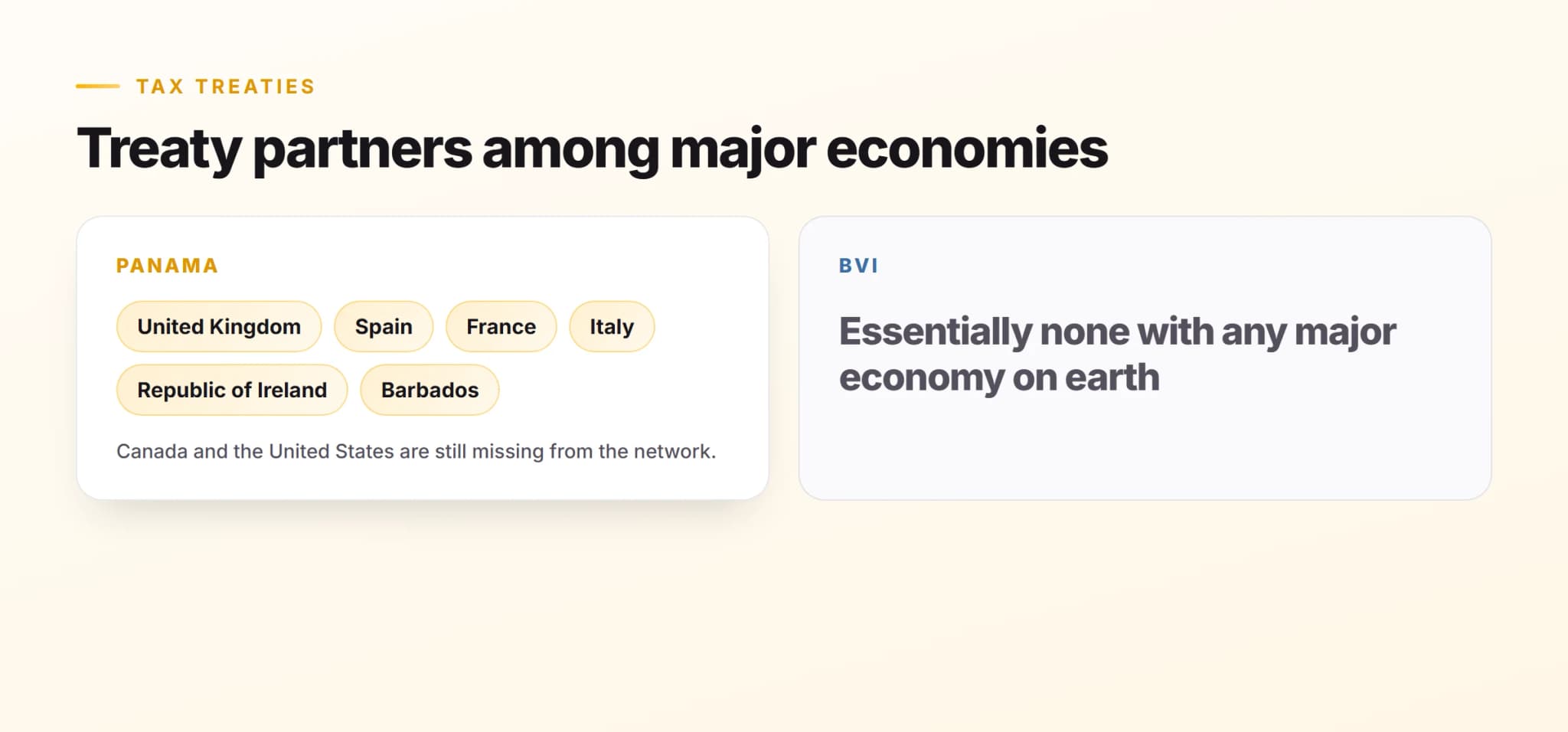
| Jurisdiction | Treaty Partners Among Major Economies |
|---|---|
| Panama | Barbados, Italy, Spain, France, United Kingdom, Republic of Ireland |
| BVI | Essentially none with any major economy on earth |
Canada and the United States are still missing from Panama's network, and that gap is worth noting. Even so, the contrast with the BVI is stark. The BVI has essentially no tax treaties whatsoever with any major economy. As global substance rules tighten, this difference will matter more to you each year. You can start to see why substance counts for so much.
6. Compliance in Both Jurisdictions
Neither option is maintenance-free. Both jurisdictions impose baseline obligations that never go away.
- In both cases, you will have to deal with a registered agent.
- In both cases, you will have to file paperwork.
- If you want an entity with zero compliance worries, neither Panama nor the BVI will be a good option for you.
7. The Benefit of Filing a Tax Return
Entities that file tax returns are preferable to entities that file nothing. The same logic explains why multi-member LLCs beat single-member LLCs in the United States. Multi-member LLCs file a Form 1065 tax return, which creates an official record of the business.
The optimal approach follows three steps. File a tax return. Show that you have substance. Ensure there is legally no tax due on that return. Panama's territorial system makes this possible in a uniquely clean way.
- You file a tax return in Panama and report your income.
- Your record is very clean and very presentable.
- Banks, regulators, and government authorities respond well to it.
- You then lawfully claim that none of the income is taxable in Panama.
- Your claim holds because the income is entirely foreign-sourced.
- This is genuinely powerful, and the BVI does not quite offer it.
There is no meaningful return to file in a zero tax jurisdiction. From a substance perspective, Panama is simply heavier. It presents better in every international business context.
8. Relocation and Residency
The final advantage is personal rather than corporate. Many people are genuinely comfortable relocating to Panama, and the pattern repeats constantly. Entrepreneurs come to Panama to set up their company and end up falling in love with the country. You are choosing a jurisdiction you could build a life around, not just a structure.
- Business owners move part of their banking to Panama.
- They buy real estate in the country.
- They spend part of the year there as seasonal residents.
- Some seasonal residents eventually become full-time residents.
The BVI offers no comparable path. Panama offers you incorporation today and, if you want it, residency tomorrow. Our overview of Panama residency for foreigners sets out the routes available once you are ready.
Final Verdict: Which Is the Best Offshore Jurisdiction?
There is no single answer for every business. Each jurisdiction serves a different profile. The BVI keeps a legitimate role for specific financial use cases. Panama serves the broader population of international entrepreneurs better.
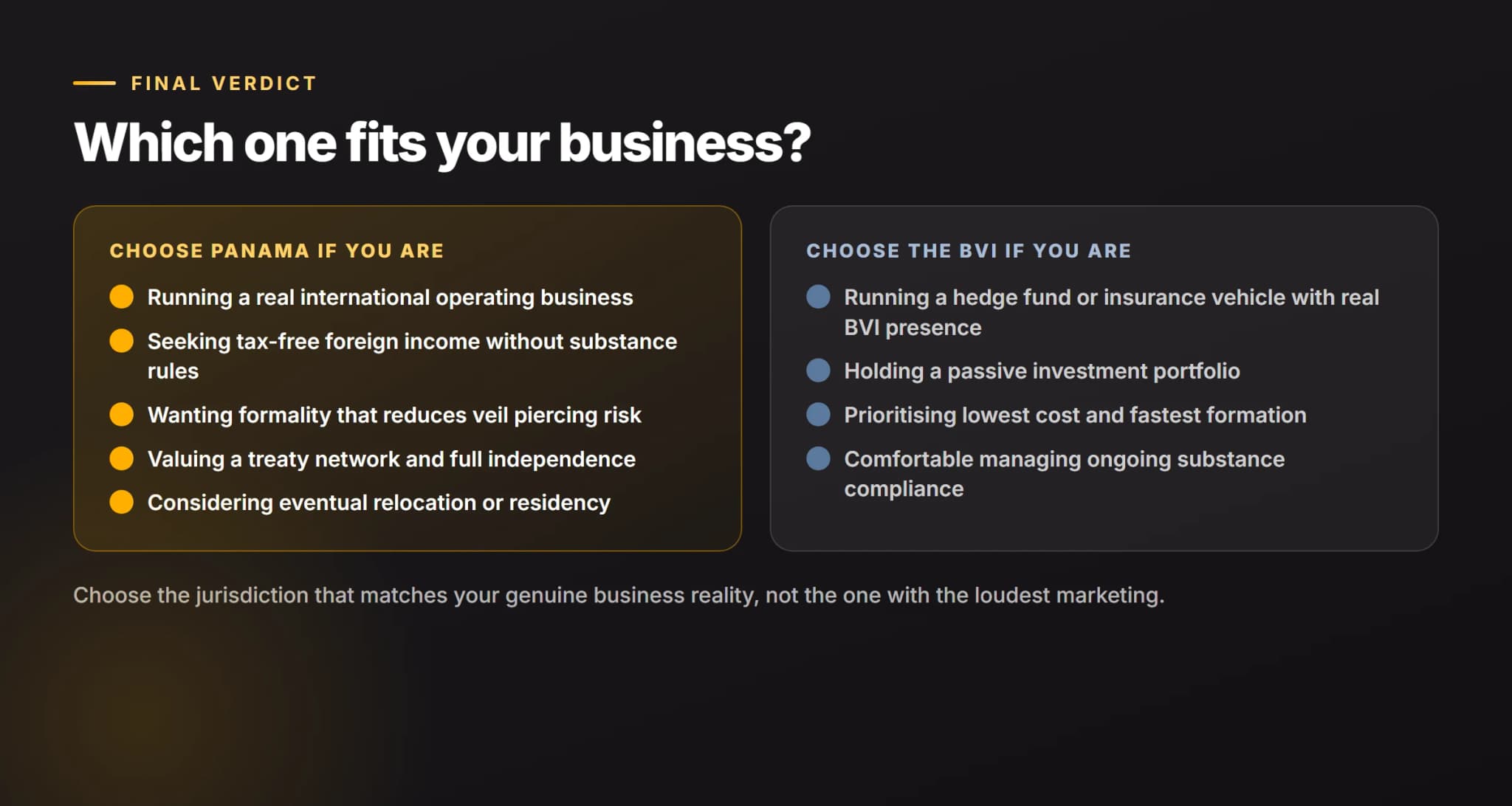
The BVI remains a strong choice if you are:
- Running a hedge fund, insurance vehicle, or genuine financial operation with real BVI presence
- Holding a passive investment portfolio within a wealth structure
- Prioritising the lowest setup cost and the fastest possible formation
- Comfortable managing ongoing economic substance compliance
Panama presents the stronger case if you are:
- Running a real international operating business
- Seeking tax-free foreign income without economic substance rules
- Looking for built-in corporate formality that reduces alter ego and veil piercing risk
- Valuing a growing treaty network, a real economy, and full national independence
- Wanting a clean tax return record that banks and regulators respect
- Considering eventual relocation or residency alongside your structure
Choose the jurisdiction that matches your genuine business reality, not the one with the loudest marketing. Tax advantages should flow from sound business decisions, never drive them. We structure Panama corporations and international entities for clients every day, and we take a substance-first approach to every case.
If you are weighing the BVI against Panama, we can assess your situation and recommend the structure that genuinely fits your business. Reach out before you incorporate anywhere, and get it right the first time.
FAQs
Is the BVI still a good offshore jurisdiction in 2026?
Yes, for specific cases. The BVI remains strong for hedge funds, insurance vehicles, and passive investment holding structures. It offers fast formation, low cost, zero tax, and wide banking acceptance. For real operating businesses, its economic substance requirements and reputation concerns weaken the case.
What is the main difference between a Panama corporation and a BVI company?
Tax structure and compliance. The BVI charges zero tax but imposes broad economic substance requirements. Panama uses a territorial system, so foreign source income is exempt, and no substance rules apply. Panama also requires a three-person board, while the BVI needs only one director.
Do Panama corporations pay tax on international income?
No. Panama only taxes income earned inside its borders. A Panama corporation dealing purely in international business earns tax-free income at the corporate level. Dividends are also tax-free, provided the company holds no notice of operations and the local licence for doing business inside Panama.
What are the BVI economic substance requirements?
They are rules requiring certain companies to prove real activity inside the territory. Covered activities include banking, insurance, fund management, finance and leasing, headquarters business, shipping, distribution and service centres, intellectual property holding, and holding companies. Intellectual property structures face the heaviest scrutiny of all.
Which offshore jurisdiction is better for a real operating business?
Panama, in most cases. It offers comparable tax outcomes, no substance requirements, built-in corporate formality that reduces veil piercing risk, and a growing treaty network covering the UK, Spain, France, Italy, and Ireland. It also offers a realistic path to residency. Consult a qualified international tax advisor before incorporating.
