

Table of Contents
Panama has become one of the most discussed destinations for crypto entrepreneurs. If you are looking for a crypto licence in Panama, here is the key fact: as of 2026, no dedicated VASP licence exists, and none is currently required. A VASP, or virtual asset service provider, is any business that exchanges, transfers, or holds digital assets for customers. You can legally run a crypto business in Panama through a standard corporation, as long as you meet the country's anti-money laundering rules.
In this guide, you will learn the legal status, requirements, costs, application process, and tax treatment of a crypto business in Panama.
Panama Crypto Licence: Quick Overview
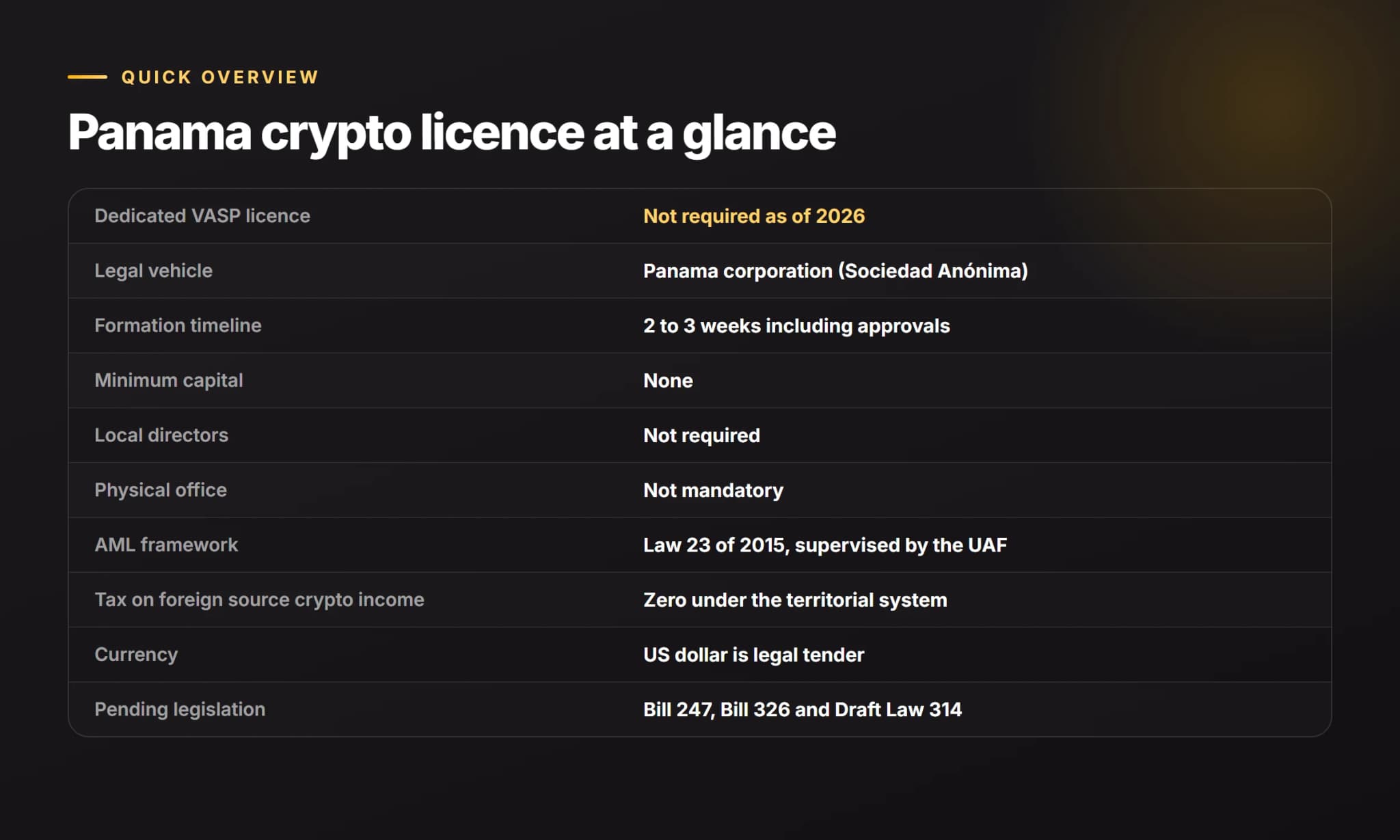
| Factor | Details |
|---|---|
| Dedicated VASP licence | Not required as of 2026 |
| Legal vehicle | Panama corporation (Sociedad Anónima) |
| Formation timeline | 2 to 3 weeks including approvals |
| Minimum capital | None |
| Local directors | Not required |
| Physical office | Not mandatory |
| AML framework | Law 23 of 2015, supervised by the UAF |
| Tax on foreign source crypto income | Zero under the territorial system |
| Currency | US dollar is legal tender |
| Pending legislation | Bill 247 (2025), Bill 326 (2025), and Draft Law 314 (January 2026) |
Is Crypto Legal in Panama?
Yes. Cryptocurrency activity is fully legal in Panama. No law prohibits the purchase, sale, custody, or transfer of digital assets. Crypto exchanges and OTC desks have operated in the country for years under normal commercial rules. What Panama lacks is a purpose-built licensing regime for virtual asset service providers. The European Union has one under MiCA, and Dubai has one under VARA. Panama does not.
The regulators have confirmed this position openly.
- The Superintendence of Banks, Panama's banking regulator, has stated that Bitcoin trading has no specific regulation in Panama.
- These activities fall outside the banking regulator's direct authority.
- The securities regulator does not treat cryptocurrencies as securities, money, or electronic currency.
- Crypto business therefore operates under ordinary corporate and AML rules.
This position works in your favour if you serve international clients through a properly formed company. Be careful if you plan to serve Panamanian retail customers, since that activity sits closest to future regulation. A detailed overview of the current framework is available in the Chambers Blockchain and Crypto Assets 2026 guide for Panama.
The History Behind Panama Cryptocurrency Regulations
Panama came close to a full crypto law once already. This history shows you how to judge the risk of future change.
- In 2021, Bill 697, a comprehensive crypto framework, was introduced. The National Assembly approved it in April 2022.
- The bill would have recognised crypto payments and created formal VASP registration.
- The President vetoed the bill twice: a partial veto in June 2022 over money laundering concerns, and a second veto in January 2023 on constitutional grounds.
- In July 2023, the Supreme Court declared the bill unconstitutional, so it never took effect.
- Panama was left without any dedicated crypto statute, which remains the position today.
Three proposals could change this.
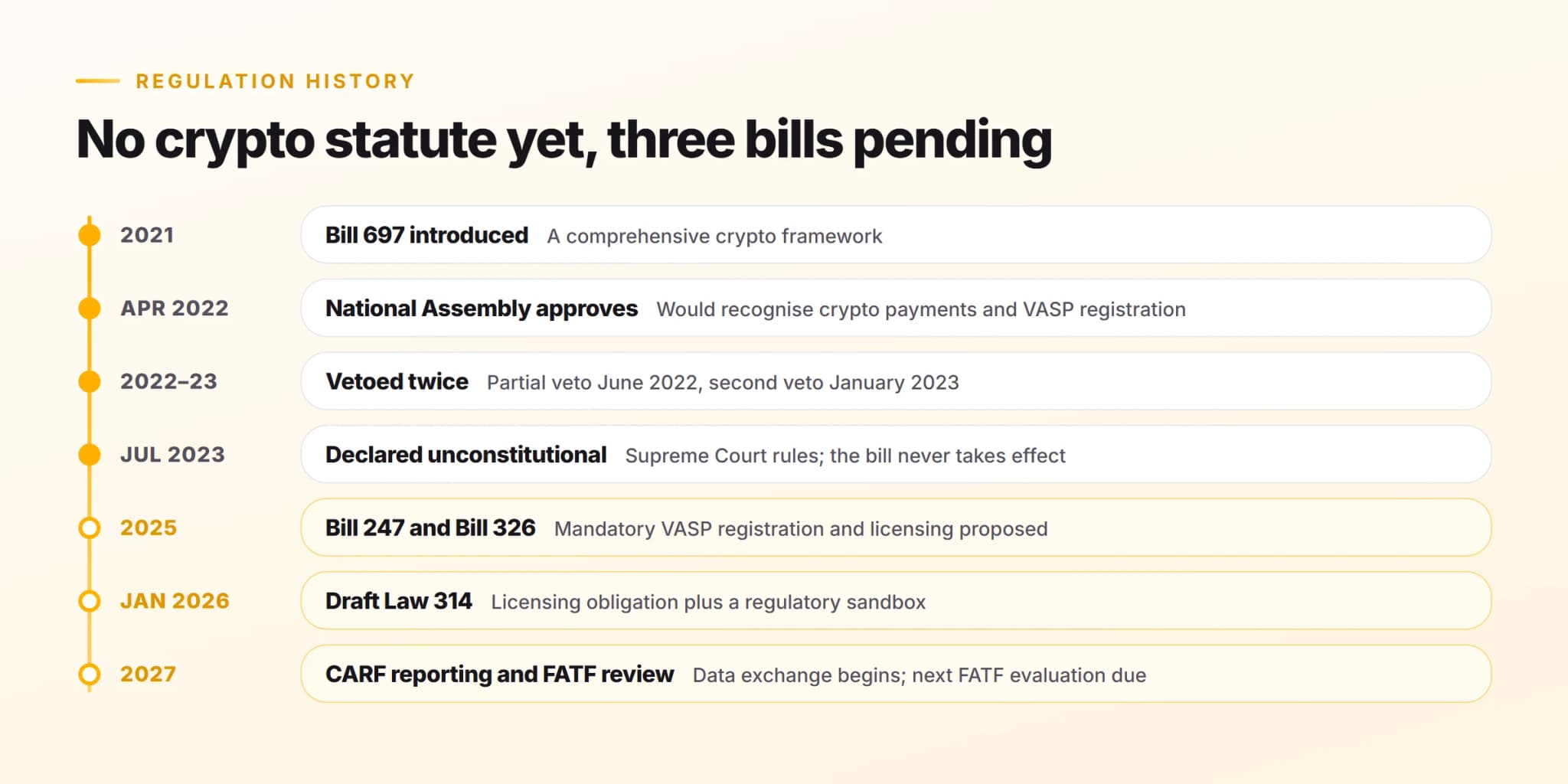
Bill 247, introduced in 2025, proposes mandatory VASP registration and a dedicated digital asset council.
Bill 326, also pending from 2025, complements Bill 247. It proposes mandatory licensing under the securities regulator (SMV), FATF-aligned AML controls, and a public VASP registry.
Draft Law 314, presented to the National Assembly on 13 January 2026, goes further. It defines VASPs, introduces a licensing obligation, and assigns supervision to the banking regulator and the financial intelligence unit. It also includes a regulatory sandbox, a controlled testing space for innovative projects.
None of these texts has been enacted. Panama's legislative process requires three separate National Assembly debates before presidential sanction, and the bills are still moving through it. Until one passes, no crypto exchange licence in Panama is required.
Two more developments matter for your planning. In December 2025, Panama signed the OECD Crypto-Asset Reporting Framework (CARF), with data exchange due to begin from 2027. And Panama faces its next FATF evaluation in 2027, which adds pressure to pass a licensing law. Expect regulation to arrive; the only question is when.
What Replaces the Licence Today
Crypto company registration in Panama follows the ordinary corporate route. You form a Panamanian corporation, known locally as a Sociedad Anónima (SA), and run your digital asset business through it. This is the standard, recognised path used by exchanges, wallet providers, custody services, and token issuers.
- Any crypto activity can run through a standard Panama SA today.
- That includes exchanges, wallets, custody, token issuance, DeFi, NFT marketplaces, and GameFi.
- No regulatory approval is needed before you start operating.
- Company registration itself takes one to two weeks, with the full setup completed in two to three weeks.
- The US dollar is legal tender, which removes currency risk from your operations.
One caution applies. Registration without a licence does not mean registration without rules. Panama's anti-money laundering framework binds you fully, and the next section explains how.
AML and KYC Requirements in Panama
AML stands for anti-money laundering, the rules that stop criminals from hiding illegal funds. KYC stands for know your customer, the identity checks that support those rules. Panama's framework rests on Law 23 of 2015 and its updates. It aligns with the Financial Action Task Force (FATF), the global standard setter for financial crime prevention. Panama was removed from the FATF grey list in 2023 after strengthening its regime, and in July 2025 it also exited the European Commission's list of high-risk money laundering jurisdictions.
Reporting oversight sits with the Unidad de Análisis Financiero (UAF), Panama's financial intelligence unit. Your crypto compliance obligations in Panama include the following.
- A risk-based AML program tailored to your business model.
- Customer due diligence, meaning full identity checks on the people and entities you serve.
- Ongoing monitoring of transactions for unusual patterns.
- Suspicious operation reports filed with the UAF when red flags appear.
- Record keeping that supports every report and diligence file.
- Screening against UN and OFAC sanctions lists.
Take these obligations seriously from day one. Banks will ask to see your AML manual before opening accounts. A strong compliance file also protects you when new legislation eventually passes. Regulators typically grant transition periods to companies already operating responsibly. If you need an AML manual matched to your business model, a specialist can prepare one for you.
Requirements for Crypto Company Registration in Panama
The requirements you will face are corporate, not regulatory. Because no licensed entity is involved, the heavy burdens found in licensed jurisdictions disappear. There are no local substance rules, no resident director requirements, and no minimum capital.
| Requirement | Details |
|---|---|
| Directors | Three individuals forming the board of the SA |
| Local directors | Not required; all three can be foreign |
| Director background | CVs showing experience in markets, finance, or the relevant industry |
| Officers | President, treasurer, and secretary; one person can hold all roles |
| Minimum capital | None |
| Physical office | Not mandatory |
| Registered agent | A licensed Panamanian lawyer or firm, required by law |
| KYC on directors | Passport or ID, proof of residency, CV, and a background questionnaire |
Two points deserve emphasis here.
- Your three directors do not need to live in Panama, unlike licensed regimes that demand local hires.
- Your directors should still be credible, with genuine experience shown in their CVs.
- A board with real financial or technology backgrounds presents far better to banks.
- A board of unqualified nominees invites problems with banks and future regulators.
Unsure whether your proposed board would pass review? A professional structure assessment before filing avoids costly rework later.
Application Process Step by Step
The process to start a crypto company in Panama is simple. It is a company registration recognised for virtual asset activity, not a licence application.
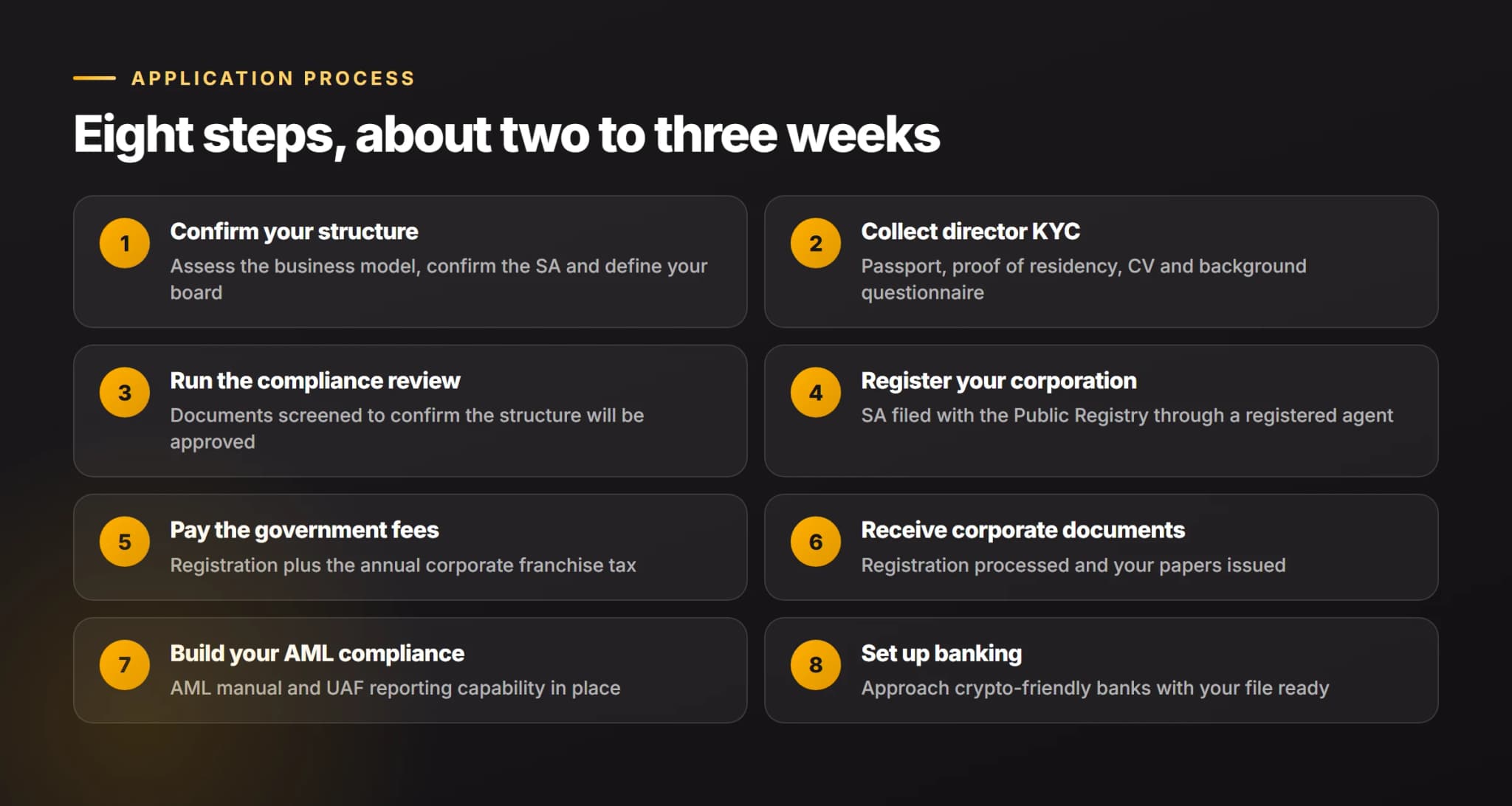
- Confirm your structure. Assess your crypto business model, confirm the SA is the right vehicle, and define your board.
- Collect KYC from your directors. Each director provides a passport copy, proof of residency, a CV, and a completed background questionnaire.
- Run the compliance review. The documents are screened to confirm the structure will be approved.
- Register your corporation. The SA is filed with the Public Registry through a registered agent.
- Pay the government fees. These cover registration and the annual corporate tax described below.
- Receive your corporate documents. The authorities process the registration and issue your papers.
- Build your AML compliance. Prepare your AML manual and set up your UAF reporting capability.
- Set up banking. Approach crypto-friendly banks with your corporate file and compliance program ready.
How Long Does It Take?
The full timeline runs about two to three weeks from document submission to operation. Compare this with licensed jurisdictions, where VASP applications routinely take six to twelve months. There are no capital checks, office inspections, or regulator interviews to slow you down.
- Document collection and KYC: a few days, driven by your own speed.
- Internal review and structuring: two to four business days.
- Registration and government processing: one to two weeks.
- Total: approximately two to three weeks to legally operate.
Crypto Licence Cost in Panama
Your budget stays modest, precisely because no licence fee exists. Your costs are formation costs plus yearly maintenance. Exact legal fees vary by provider, so treat the figures below as typical market ranges. Confirm a full quote before you commit.
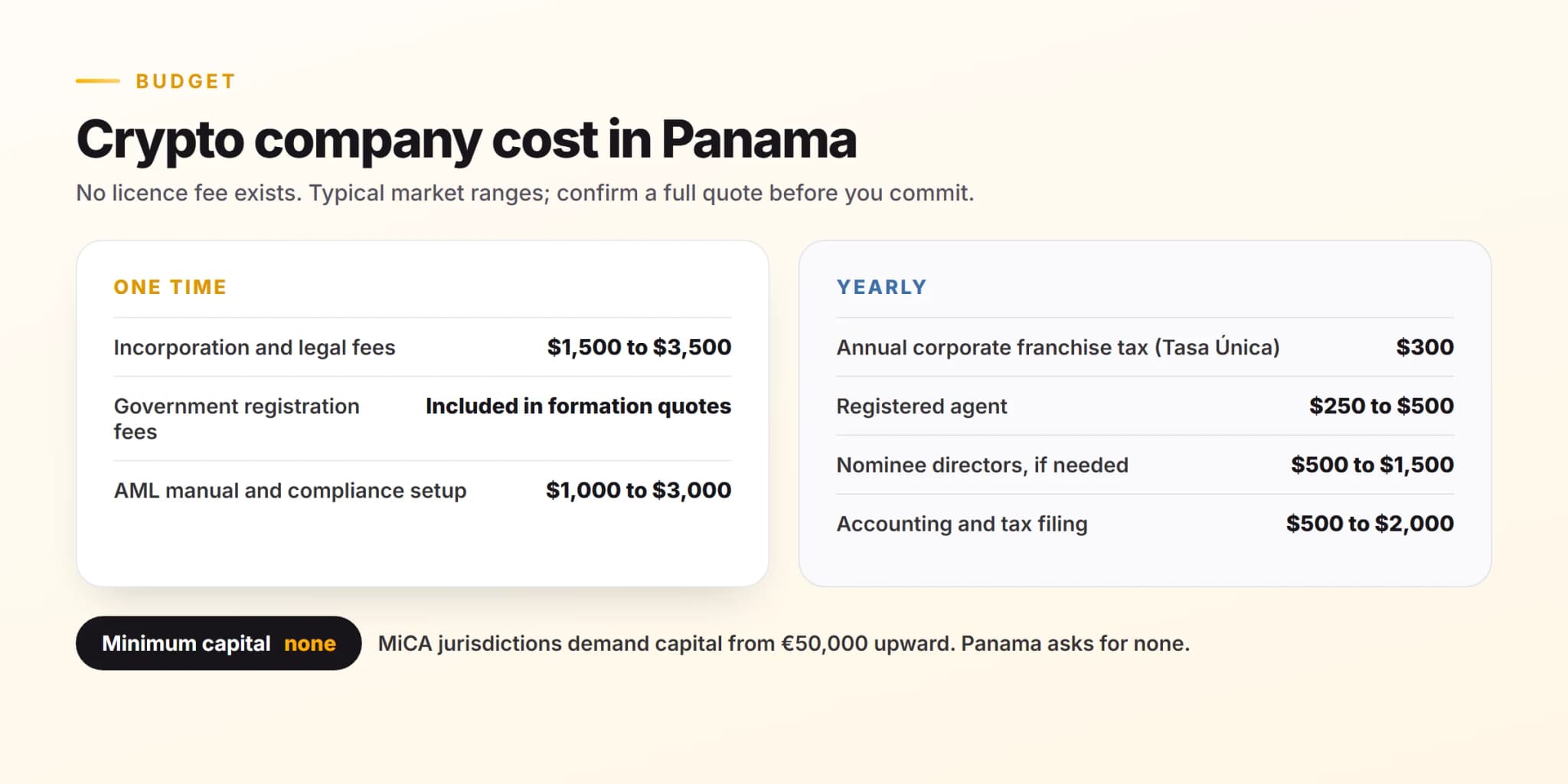
| Cost Item | Typical Range | Frequency |
|---|---|---|
| Incorporation and legal fees | $1,500 to $3,500 | One time |
| Government registration fees | Included in formation quotes | One time |
| Annual corporate franchise tax (Tasa Única) | $300 | Yearly |
| Registered agent | $250 to $500 | Yearly |
| Nominee directors, if needed | $500 to $1,500 | Yearly |
| AML manual and compliance setup | $1,000 to $3,000 | One time |
| Accounting and tax filing | $500 to $2,000 | Yearly |
There is no minimum capital requirement, which removes the highest cost in licensed regimes. MiCA jurisdictions demand capital from €50,000 upward. Panama asks for none.
Panama Crypto Tax Regulations
Panama runs a territorial tax system. Territorial taxation means only income earned inside Panama is taxed. Foreign source income is simply not taxed. No special holiday applies, and no special regime requires qualification. The exemption is automatic.
Foreign assets are treated as generating foreign source income. Here is what that means for you as a digital asset holder.
- Crypto held on offshore exchanges or in wallets outside Panama counts as a foreign asset.
- Selling that crypto as a Panama tax resident generates foreign source capital gains.
- Those gains carry zero Panamanian tax.
- The same logic covers gold stored abroad and stocks traded on foreign exchanges.
- Shares on the New York Stock Exchange, held through foreign brokerage accounts, qualify fully.
An extra layer benefits you if you are a non-US person. A non-resident alien is someone who is not a US citizen, holds no green card, and spends limited time in the US. Under US law, when a non-resident alien sells shares of US companies, those capital gains are usually exempt from US tax as well. Note that US-source dividends are different: they typically face a 30% US withholding tax, reduced only where a tax treaty applies. If you are Canadian, Australian, or British and properly exit your home tax system, you can hold US investments from Panama and pay zero capital gains tax on both sides.
One transparency note. Panama's CARF membership means that from 2027, information about your crypto held through Panamanian service providers can be shared with your home tax authority. Your gains stay untaxed in Panama, but they will not stay invisible. Plan your tax residency properly.
Article 694: Running the Business From Panama
Article 694 of Panama's tax code takes territorial taxation one step further. It names two activities you can run from Panamanian soil that still count as foreign-source, tax-free income.
International trading. Buying goods in one foreign country and selling them in another stays untaxed. The goods must never enter Panama. This holds even when you manage the operation from a Panamanian office.
Directing foreign transactions. Managing deals that take effect abroad also stays untaxed. The deals must be economically foreign, and the counterparties must not be Panamanian residents.
The practical result: you can open an office in Panama City and direct the buying and selling of foreign crypto, gold, and shares. Deal only with international counterparties, and everything remains tax-free. Costa Rica, Uruguay, and the Dominican Republic offer partial equivalents through free zones, but their rules are narrower. Panama's territorial system is the most flexible in the Americas.
A Note for US Citizens
If you are a US citizen, you are taxed on worldwide income regardless of where you live. Moving to Panama does not remove your US filing obligations, and you cannot directly exclude capital gains. Structuring still helps. Operating through a company and paying yourself a salary can unlock the Foreign Earned Income Exclusion. That exclusion lets you shield a large portion of salary income from US tax if you qualify. A lower cost of living adds a further practical benefit.
Panama Crypto Banking
Set realistic expectations around banking. Panamanian banks remain conservative toward digital asset businesses. The banking regulator has instructed banks to apply full due diligence to crypto-linked clients. Your structure and compliance file determine your access.
- Present a complete AML program before approaching any bank.
- Expect enhanced checks on directors, shareholders, and source of funds.
- Many crypto businesses pair a Panamanian corporate account with foreign crypto-friendly banks and payment institutions.
- A credible board with documented financial experience improves your approval odds.
- Clean tax filings under the territorial system strengthen every application.
Risks and What to Watch in 2026
Balance the advantages against the moving parts. The pending bills are the main variable. If Bill 247, Bill 326, or Draft Law 314 passes, a VASP licence regime in Panama becomes mandatory. Existing companies will most likely receive a transition period to register. That rewards you if you build a compliant structure early. Companies operating without AML controls will struggle to survive a formal licensing transition.
- Monitor the National Assembly's progress on Bill 247, Bill 326, and Draft Law 314.
- Build your AML and KYC program now, not when the law forces you.
- Prepare for CARF reporting from 2027 and the FATF evaluation the same year.
- Keep accounting records clean and foreign source income well documented.
- Avoid serving Panamanian retail clients until the licensing framework clarifies that activity.
- Reassess your structure annually as Panama blockchain regulations evolve.
Should You Set Up Your Crypto Company in Panama?
Panama offers a unique opportunity in 2026. Crypto activity is legal, the setup takes two to three weeks, and there is no minimum capital requirement. You don't need local directors, and your foreign source crypto gains are not taxed. The trade-off is a lack of regulatory maturity. There is no licence available for institutional partners, and pending laws could change the rules within a year or two. If you run an exchange, wallet provider, token project, or trading operation serving international clients, the case for Panama is strong. If you need a formal licence for institutional credibility, a MiCA or VARA location may suit you better, but at a significantly higher cost.
We help entrepreneurs and investors structure crypto companies in Panama with a substance-first approach. If you are planning a crypto company formation in Panama, we can review your model, prepare your compliance framework, and manage the registration end to end.
Reach out before you incorporate, and enter the market with a structure built to outlast the coming regulations.
FAQs
Do I need a crypto licence in Panama?
No. As of 2026, Panama has no dedicated VASP licensing regime. You can operate legally through a standard Panamanian corporation, known as a Sociedad Anónima. You must still comply with Panama's anti-money laundering rules under Law 23 of 2015, supervised by the UAF.
How much does it cost to start a crypto company in Panama?
Budget roughly $3,000 to $7,000 for the first year. This covers incorporation and legal fees, the $300 annual corporate franchise tax, a registered agent, and AML compliance setup. There is no minimum capital requirement, unlike MiCA jurisdictions that demand €50,000 or more.
How long does crypto company registration in Panama take?
About two to three weeks from document submission to operation. Company registration completes in one to two weeks, with the remaining time covering compliance review and government processing. Licensed jurisdictions typically take six to twelve months for comparable VASP approvals.
Is crypto income taxed in Panama?
Foreign source crypto income is not taxed. Panama's territorial tax system only taxes income earned inside the country. Crypto held on offshore exchanges or foreign wallets counts as a foreign asset, so your gains from selling it as a Panama tax resident carry zero Panamanian tax. From 2027, CARF reporting will share account information internationally, so your tax residency must be structured properly.
Will Panama introduce a VASP licence in the future?
Likely, yes. Bill 247 and Bill 326 from 2025 and Draft Law 314, presented in January 2026, all propose mandatory VASP licensing. None has been enacted. If you already operate with a compliant structure, you will most likely receive a transition period to register.
